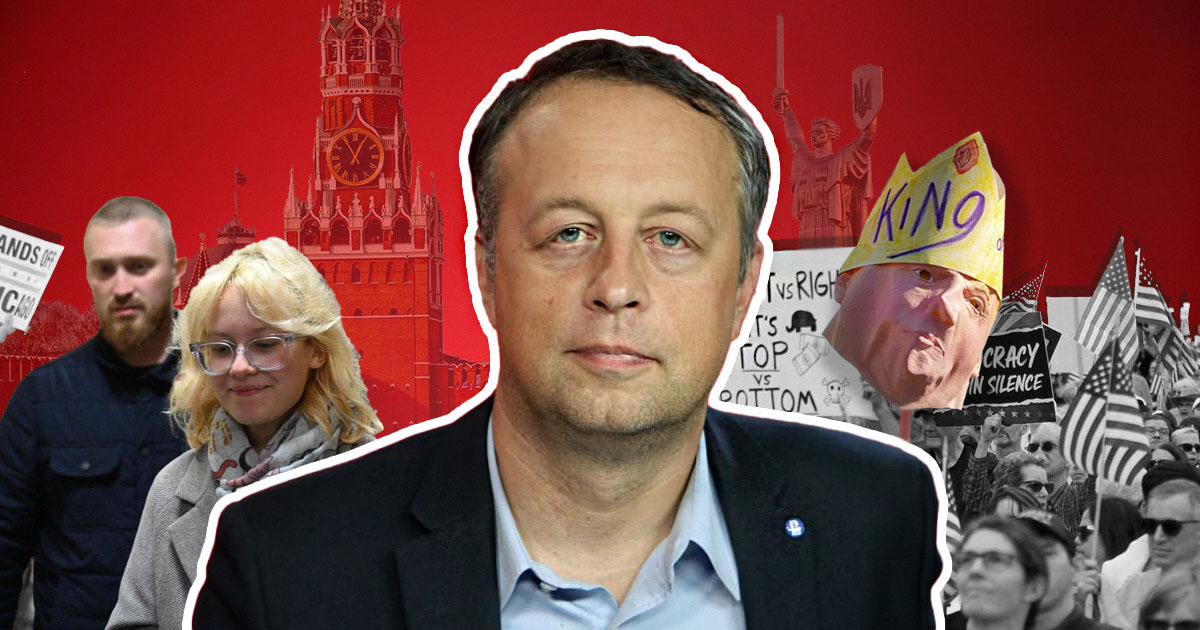
Konstantin Sonin (center)
Evgenia Albats*: The news from the past week is overwhelming. Let's start with the 13-day arrest of 18-year-old street singer Diana Loginova, also known as Naoko, along with her band members, the drummer and guitarist. The protocol stated that the musicians obstructed pedestrian traffic, making it difficult for them to enter the metro. In reality, their guilt lies in singing songs by "foreign agents" Monetochka* and Noize MC*. And practically all the leading presenters of the channel "Dozhd"** were added to the list of extremists. What do you say?
In Russia, millions of people, all the youth, are waiting for a return to normalcy. They want to sing Monetochka's songs, listen to Morgenstern*, and want to buy books by Akunin***, Bykov***, and Glukhovsky* in stores
Konstantin Sonin: This news, like you, I think, did not seem unexpected. What does the arrest of Diana Loginova show? It shows that in Russia, millions of people, all the youth, are waiting for a return to normalcy. People just want to live normally, humanely, and not under the conditions of the idiotic nonsense imposed by Putin and his company.
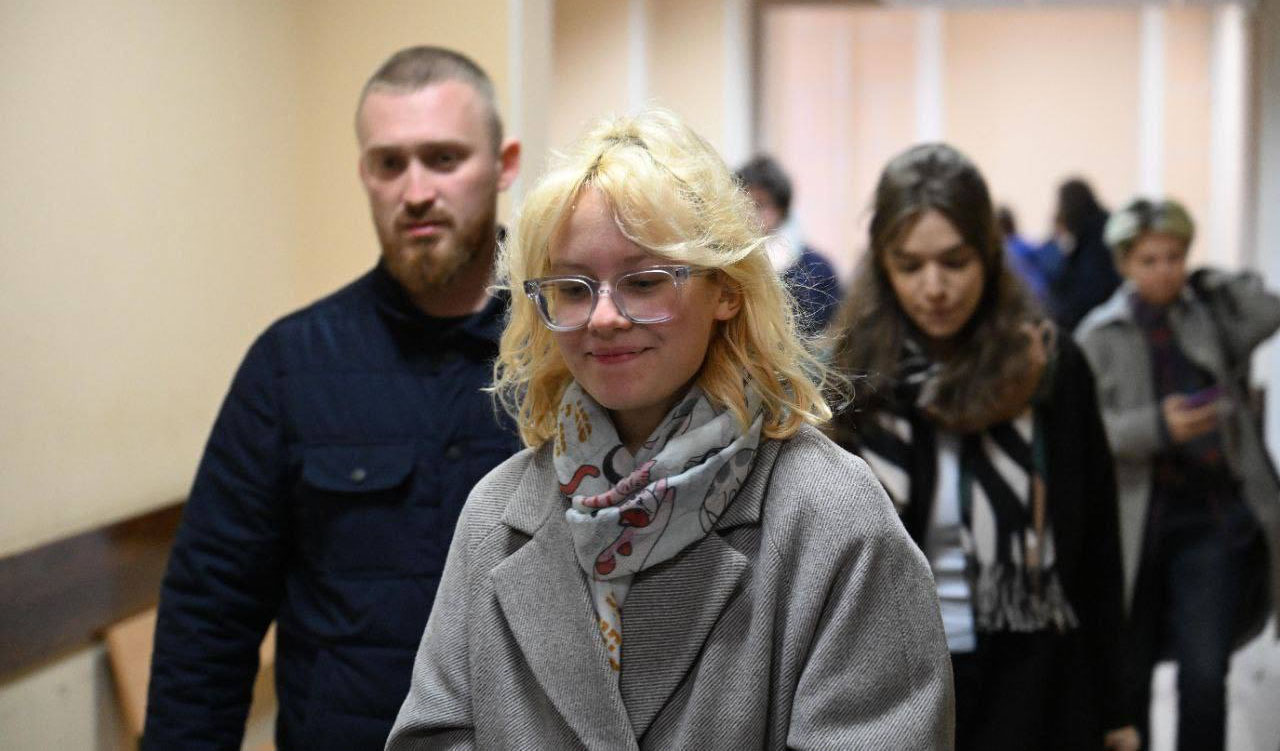
Singer Stoptime Naoko was arrested for 13 days. Photo: "Fontanka"
Who is against the war?
Evgenia Albats: In my seminar at New York University, called "Russia and Its Neighbors in Search of a New Paradigm," Harvard University professor Oleg Itskhoki* said he is still surprised that neither in Russia, nor in the diaspora, nor in the emigration, which is very large, there is no mass anti-war movement. It seems to me that in Russia, no protest is possible if people are jailed for songs. People have every reason to be afraid to open their mouths, let alone go out into the streets. Although in several cities in Russia, there are still solitary pickets in support of Diana Loginova. What do you think, Konstantin, why is there no anti-war movement?
Konstantin Sonin: An anti-war movement, like in America in the 60s or in France, made sense in a democratic society where the country's government pursued its policy, and at the same time, there were many people who disagreed with this policy, they organized demonstrations, helped elect anti-war candidates, and ultimately, their protests ended these wars. In Russia, there is no anti-war movement due to severe political repression. It may not be mass killings like under Stalin. But it is a harsher regime than in Soviet times. These are real mass political repressions. What kind of anti-war movement can there be in such a situation? I am sure that if there were more or less normal elections, any anti-war candidate would easily defeat Putin because, according to all the data we see, most Russians do not support the war. There are two to three million who support it, there are paid propagandists, but the majority do not want war.
Why is there no anti-war movement abroad? All the main Russian intellectuals, all the major Russian writers, all the famous poets, all the leading scientists of Russia, wherever they are, are all against the war. They are not silent. But I don't quite understand what kind of movement there could be. There is no authority here that could stop the war, and the help to Ukraine, the help to people suffering from repression in Russia, is quite massive.
Evgenia Albats: You said you have no doubt that most people in Russia do not support the war. I completely agree with you. But many American political scientists who study Russia, including Columbia University professor Timothy Frye, who recently said they conducted a survey (I don't understand how they could conduct a survey in Russia), and according to their data, 80% of Russians support the war. Now many professors from various American universities are trying to count those in Russia who are for the war, who are against it. They try to do this by studying the internet. But you unequivocally claim that the majority are against the war. How do you know this?
Konstantin Sonin: Those who are currently conducting surveys in Russia (those who can be trusted) accompany this with reservations that surveys in authoritarian regimes should not automatically be compared with survey data in democratic countries, which can be compared with election results, for example. There is a connection between the number a sociologist received in response to a question and the number of votes received for a candidate. And what was measured in Russia — support for Putin over 25 years, was a number that is not verified by people voting in free elections. In Russia, they measure what cannot be verified. But there are indirect indicators. You can look at the fact that 80% of Russians in surveys support the "special military operation," but you also need to look at the fact that in the same region, a 10-fold annual income is paid as a signing bonus, but people do not go to fight on contract. Both pieces of evidence are indirect, but the second is not an interpretation; it is a concrete action. And it seems to me that all the data about how many people looked on the internet for ways to avoid mobilization, how many people rushed across the border into Georgia in 2022 when there was a wave of mobilization — these are direct pieces of evidence. And what some political scientists say when addressing the general public — this is just poorly done science, low-quality research.
If 80% of Russians supported the war, there would be no arrests, no fines, no criminal cases. Criminal cases are a direct sign that a huge percentage of the population is against the war
Evgenia Albats: Unfortunately, these low-quality studies and analyses are repeated over and over. It seems to me that those who say they are measuring something in Russia are actually measuring fear.
Konstantin Sonin: Yes, of course, fear. There are people like Scott Gehlbach, my colleague from the political science department, who try to apply a special methodology where people are given the opportunity to answer questions so that their fears are not directly transmitted. And they still see some support for Putin. But firstly, these surveys show much lower support, and secondly, the reliability still suffers from people being afraid to answer.
Evgenia Albats: They started being afraid to answer even before the war began.
Konstantin Sonin: In jurisprudence, there is even a term — the possibility of making a negative interpretation of data from the refusal to provide it. You see, if in a country they imprison people for anti-war statements, if in a country they do not allow anti-war candidates to participate in elections, this already means that there is a majority with anti-war sentiments. Otherwise, they would allow it. If 80% supported the war, there would be no arrests, no fines, no criminal cases. Criminal cases are a direct sign that a huge percentage of the population is against the war. And against Putin.
Evgenia Albats: I think that the detention of singer Diana and her colleagues is precisely evidence that the authorities are afraid of any utterance, they understand that people still watch and know Monetochka on the internet. But when on the streets of St. Petersburg you hear "it was in Russia, it was long ago, it was in Russia, it was in a dream" — it resonates at least with young people. I think not only with the young.
Konstantin Sonin: If 80 percent of Russians supported the war, everyone would be walking around and spitting...
Evgenia Albats: And she was being sought throughout St. Petersburg to listen to her. They suddenly became an extraordinarily popular band.
Konstantin Sonin: Pay attention. As soon as you focus on finding direct signs, everything becomes clear. There are some graphomaniacs who are for the war... No one buys or reads Zakhar Prilepin's books. They publish some collections of "correct" poetry, no one buys them. In a country where there would be real support for the war, it would not be necessary to ban Glukhovsky because he would not be popular.
The Purpose of Repression
Evgenia Albats: Konstantin, you mentioned the growth of the repressive system. But why do they include famous people in the lists of extremists and terrorists? What's the point? You were given a sentence, convicted in absentia. It's clear that you won't go to Russia. Anna Mongait* was given a sentence, others very famous presenters of the channel "Dozhd" are being pursued. They are persecuting Bykov*, Itskhoki*, Glukhovsky, Akunin, Guriev*. Do you have any idea why they are doing this?
Konstantin Sonin: Why — is a bad question in political analysis. If you ask why Stalin killed Mandelstam and Babel, you can come up with something for each individual person. Why did Stalin destroy the leading mathematicians, physicists, biologists, poets, writers? There is no "why" here, we must look for another explanation.
Evgenia Albats: It doesn't seem to me that this is a completely hopeless question. Stephen Kotkin, in the second book of his trilogy about Stalin, provides an answer. He shows how Stalin was frightened when Trotsky published his book in the West, in France, and it became quite popular in certain leftist circles. And then Stalin began to destroy what had been built before, searching for Trotskyists everywhere. It seems to me that Kotkin managed to show Stalin's fear and his rationality in mass terror. But what is the goal in compiling lists of people you still cannot reach?
Konstantin Sonin: The endless goal is to keep oneself in power. And the motive for retaining power is not only with Putin, it is the same with Bortnikov and Patrushev, with Prilepin and Solovyov, and so on. In a normal situation, if there were elections in Russia, they might have also been removed from these positions long ago because there would have been a new president. But they want to cling to their place permanently, forever. The same in literature, art, journalism. Fighting talented people is the way untalented people maintain their positions.
The Economy of Loyalists
Evgenia Albats: With Oleg Itskhoki, we discussed the question of how long Putin can continue the war, how long the Russian economy can withstand this war. According to his analysis, sanctions and economic pressure will not be able to stop the war. After all, soon Russia's full-scale war in Ukraine will be as long as the Great Patriotic War. But we see that Putin managed to choose not only loyal but also quite competent economists. And his technocrats have quite fit into the system; Putin can drag out this war for so long because he has a good economic team.
Konstantin Sonin: Oleg and I have slightly different opinions on this matter. The Central Bank is now in a much worse position than when Elvira Nabiullina received it in 2013. In 2013, there was no absolute trust in the words of the Central Bank chairman, but now there is none at all. Over these years, we have learned that the Central Bank can lie like the leadership of the Soviet State Bank once did, like Prime Minister Pavlov once lied. It took 20 years to create the reputation of the Central Bank, but Nabiullina flushed this reputation down the toilet. Ksenia Yudaeva created a research department there, but who needs these Central Bank studies if their publications are now completely subordinated to political logic? It seems to me that they don't even read what they write themselves. The same goes for Siluanov. If you perceive the Russian Minister of Finance as a person who does bookkeeping and sends money where told — not for building houses, hospitals, schools, but for producing drones — yes, then such a finance minister is competent. But if you think of the finance minister as a person responsible for Russia's economic development, as reformers in Gaidar's government were once responsible, and Gaidar himself when he was finance minister, and Boris Fedorov, and Alexander Livshits, then Siluanov is the worst of them. Now a competent finance minister is one who fulfills the president's wishes, not one who cares about Russia's economy and economic development.
Why is the Russian economy still intact? Because it was in good shape, but not thanks to Putin and his company, but thanks to the people who built businesses, who invented innovations, who brought Western inventions, who worked all these years. The Russian economy before the war was in good shape. Therefore, it is still withstanding the torturous conditions it is in because of the war.
Russians eat worse products, eat less, receive fewer services. If you look at the production of missiles and drones, it hasn't fallen. But the production of everything else that is important for life, for the economy — has fallen, and quite noticeably
Evgenia Albats: In the summer of 1922, I was still in Moscow and remember, all the talk was about the economy collapsing, it couldn't withstand the sanctions, the freezing of half of the Central Bank's reserves — it was a nightmare and horror. And so on. I remember one of the leading economic journalists of "Kommersant" Dmitry Butrin said that we are rolling back somewhere to the 50s. None of this happened.
Konstantin Sonin: Why "nothing happened"? Russians eat worse products, eat less, receive fewer services, it's quite noticeable. I understand that if you add up the production of missiles and drones, then production hasn't fallen. But the production of everything else that is important for life, for the economy, has fallen, and quite noticeably.
Evgenia Albats: Businessmen in Moscow say: of course, this war shouldn't have been started, it's complete idiocy. But now it needs to be won. And overall, it's not that bad.
Konstantin Sonin: If you talked to young businessmen in 1990, you would hear — what a life! Of course, there are always winners and always losers.
If you perceive sanctions on businessmen as punishment for bringing about the war, then that's wrong. They are not the culprits of the war. Business is generally what is against war
Evgenia Albats: Evgeny Chichvarkin*, a successful businessman forced to flee Russia earlier than others, claims that the sanctions imposed by the West against individuals, against businesses, only helped Putin because businessmen were forced not only to return to Russia themselves but also to repatriate their money. They thus created support for Putin among the business nomenclature, among those allowed to enjoy the spoils, including companies left by foreigners in Russia and nationalized by Putin's decrees. He also talks about the problems created for Russian emigration in terms of obtaining work visas and the problems created for Russian businesses, all of which benefited Putin. What do you think about this?
Konstantin Sonin: If you perceive sanctions as punishment for businessmen for bringing about the war, then that's wrong. They are not the culprits of the war, many businessmen have always, all their lives, been against the war. Business is generally what is against war. And even the most odious of them, if you look closely, spoke out against the war. The same Deripaska, only not many listened to him. But if you think of sanctions as something that will bring the end of the war closer, then I believe in that. Every penny taken from Russian business — is a minute closer to the end of the war, a minute closer to the end of Putin's regime. Even if these are sanctions on the best, most innocent, most honest person. In this sense, there is no mistake in the sanctions. Every penny not going to Russia — is fewer bombs falling on Ukrainian cities, fewer missiles, fewer drones, fewer payments to mercenaries fighting in Ukraine. Another thing is that there are stupid measures. Many people from Russia would contribute to the economy and culture of the countries they fled to if they were accepted there. I, for example, thought that universities in Eastern Europe and former USSR countries could, thanks to emigrant scientists, raise their mathematics and natural science faculties to another level. They could hire excellent Russian professors of much higher quality than in these universities, but they simply do not want to see any Russians because of the war in Ukraine.
Whose Side is Trump On?
Evgenia Albats: The economy of the European Union is 5–6 times larger than the economy of Russia in terms of GDP. The European Union has only now realized that it needs to invest more in defense, including to help Ukraine, but not only. Poland is preparing for war with Russia and is increasing its investments in the military-industrial complex to 5% of GDP, which of course seriously affects the prospects of Tusk's government. Nevertheless, they understand that they have no choice. People coming from Kyiv say there are many foreigners there, and everyone seriously expects Putin to attack Europe. What do you think about this?
Konstantin Sonin: I think there is no predetermination here. But if Putin stays in power for a long time, an attack on the Baltic states is possible. Currently, the Baltic states are protected from attack by the Ukrainian army: Putin cannot withdraw divisions from the occupied territories of Ukraine, where fighting is taking place.
Evgenia Albats: Yes, but China is helping Russia. We see that the production of long-range missiles has not decreased. And "Calibers," "Iskanders" endlessly hit Ukrainian cities.
Konstantin Sonin: If you correctly understand China's main interest, you can see why it helps Russia. Because the best thing for China is for the Russian-Ukrainian war to continue forever. By attacking Ukraine, Putin gave China a gift that no one has given in the last century.
Trump lives in a world partly formed in the 70s and 80s. And when he talks to Putin, he imagines he is talking to Brezhnev or Khrushchev, that is, the great leaders of another great power. He doesn't notice that both Putin is smaller, and Russia is far less important, and the issues are completely different
Evgenia Albats: Commentators in Europe have again started talking about how Putin somehow managed to sway Trump to his side. I recently read that in the National Security Council, in the National Security Council of the United States, which traditionally was the main collective advisor to the president on foreign policy issues, now works 36 people. In the Biden administration and the Obama administration, there were 400 people. The National Security Council always had representatives from various American agencies, seconded by the CIA, FBI, intelligence, etc. At the same time, we observed a very breakthrough decision on the Middle East. And the third fact — protests in all major cities of America, including Chicago, where you are, and in New York, where I am. In New York, at least 100,000 people came out. And in total, according to Democratic Party officials, 7 million people across the country took part in the "No Kings" protest. What do you think about this? What do you think about Trump's decision regarding Ukraine-Russia?
Konstantin Sonin: It seems to me that from the very beginning of Trump's presidency, his attitude towards the war in Ukraine is determined by two factors. One factor is that Trump lives in a world partly formed in the 70s and 80s. And when he talks to Putin, he imagines he is talking to Brezhnev or Khrushchev, that is, the great leaders of another great power. He doesn't notice that both Putin is smaller, and Russia is far less important, and the issues are completely different. The second factor is that in American society, and among ordinary Americans, and in the elites, there is a clear understanding of the need to support Ukraine. Ukraine is a victim of aggression. Russia unprovokedly attacked a peaceful neighbor and occupied part of the territory. This perception in society is extremely clear. Americans are willing to spend money to support the victim of aggression, to uphold international norms. And this sets the entire dynamic of President Trump's actions. We constantly see a swing from a policy of deals under television cameras to an understanding of national interest.
The size of the National Security Council is a secondary issue.
Evgenia Albats: These are related things. It indicates whether Trump is getting enough information.
Konstantin Sonin: I will slightly untangle this connection now because it is necessary to understand that the Russian-Ukrainian war and everything happening in Europe is not the main thing in American politics. There are much more important things. President Trump brought to power a broad Republican coalition, very diverse. In particular, one of the cores of his coalition is the Republican establishment for lowering taxes and reducing the role of the state. They don't care at all about what happens outside America. Their task is to reduce the size of the state, and they are reducing it. They sharply reduced the staff of the Ministry of Foreign Affairs, all departments related to security. Democrats predict that the quality of the diplomatic service, the quality of intelligence will sharply deteriorate as a result. And Republicans say: no, it won't deteriorate because you have inflated the state beyond all measure. And so far, it must be said, the small Trump administration is handling some issues better than the traditional bureaucracy under Biden. Accordingly, Republicans have a reason to credit themselves with this success.
Evgenia Albats: They will tell you that Trump reduced the National Security Council so much to reduce the number of people who tie his hands. This gives him the opportunity to issue decrees.
Konstantin Sonin: In America, there is democracy, and much of what the Trump administration does is what he intended to do. The American majority voted for a candidate who wanted to end the FBI and CIA as we know them. There are a huge number of places where efficiency could be increased — that's true, Trump didn't invent it. Although those who advocated for reduction successfully took advantage of his vindictiveness and desire to settle scores.
Evgenia Albats: Shleifer's works, a well-known economist, show that every time Republicans are in power, the number of bureaucrats ultimately grows, not decreases.
Konstantin Sonin: But Trump managed to reduce it. Unfortunately, primarily what is easier to cut — spending on science, for example.
Americans Against Usurpation
Evgenia Albats: What do you think about the No Kings protest? It has become fashionable among Russian opposition journalists to say that the regimes in Russia and the United States are not much different, that Trump is attacking freedoms, waging a war against the media. But what does the seven-million protest show?
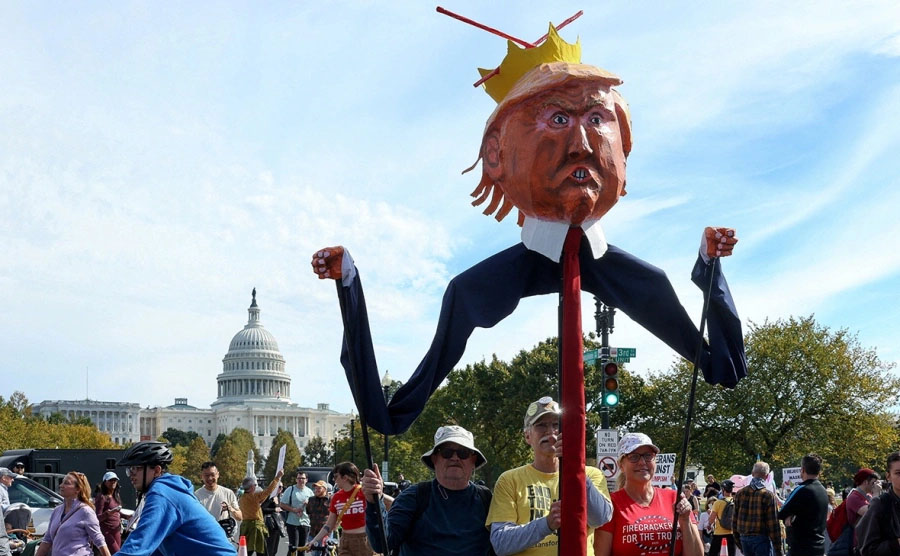
Protests No Kings in Washington, USA. Photo: Kylie Cooper / Reuters
Konstantin Sonin: This is a mega-important question. If you think about what is special about America, why this country has been a leader in global development for the last 200 years, why it is almost the only country in the world where elections are held regularly every 4 years, the opposition comes to power, and this process is completely unchangeable. What makes America special? It is that they start worrying about their state structure, about it being taken over by someone, at a very early stage. My colleagues at the faculty ask me: well, you saw how democracy is being destroyed in Russia, and the same thing is happening here. I tell them that, on the one hand, there is nothing to worry about, nothing similar. On a scale of danger, there were 60–70 threats in Russia, and here 3. Or maybe 1–2. On the other hand, I think they are worrying correctly. Everything Trump does, different presidents have done throughout history. They pressured the courts, federalized the National Guard, sent troops somewhere. And political opponents were imprisoned. Not just criminal cases were initiated, as now, but imprisoned a hundred years ago. It all happened. But maybe this is their difference, Americans, that they start worrying very early. That there is really no threat to democracy yet, and next year, of course, the Democratic Party will take a majority in the House of Representatives, but they are already going out to rallies and meetings because they fear the usurpation of power.
Evgenia Albats: It seemed to me that there is an overreaction with alarmism here. Probably, journalists also called you and said: well, you see, the same thing is happening here as it was in Russia...
Konstantin Sonin: You see, they usually have serious elections here from the fifth grade. Serious elections in any teacher's council, in any public school. People seriously argue about who will win. And they are really afraid that this opportunity — to choose — will be taken away from them. When I think about Russia, I try to understand when we lost Putin, when civil society did something wrong — it's somewhere around 2002, maybe 2004.
Evgenia Albats: By 2008, everything had already happened. Putin's silent coup.
Konstantin Sonin: Well, there you go. And Americans react early to threats.
Evgenia Albats: When Yeltsin announced Putin as his successor, we should have jumped up and said: what successor? What kind of successor? And there were all sorts of discussions about what it would be like under the new president, what kind of bureaucracy there would be, and among our close acquaintances, very democratic people, there were supporters of authoritarian modernization.
Konstantin Sonin: Well, Americans really have a sensitivity to their right to express themselves, to their right to change power. Not only the president but also to change the local judge, the local dean, the local director, the local governor, they are extremely sensitive to this. We seem to be seeing this sensitivity manifest now. And not only among Democrats. Trump is largely a reaction of conservatives to what they felt was their voice being taken away.
Evgenia Albats: In any case, I understand that you agree with me that comparing today's regime in Russia with America is completely impossible...
Reference
Konstantin Sonin — Professor of Economics and Public Policy at the University of Chicago (USA). Formerly a professor at the Higher School of Economics and the Russian Economic School. The Russian authorities sentenced Sonin to 8.5 years in prison for posts about the crimes of the Russian army in Bucha.
Video Version
* Evgenia Albats, Konstantin Sonin, Oleg Itskhoki, Sergei Guriev, Monetochka, Noize MC, Morgenstern, Anna Mongait, Dmitry Glukhovsky, Evgeny Chichvarkin are declared "foreign agents" in the Russian Federation.
** "Dozhd" is declared a "foreign agent" and "undesirable organization."
*** Dmitry Bykov, Boris Akunin are declared "foreign agents" and included in the register of "terrorists and extremists."
Photo: RFE/RL Graphics.