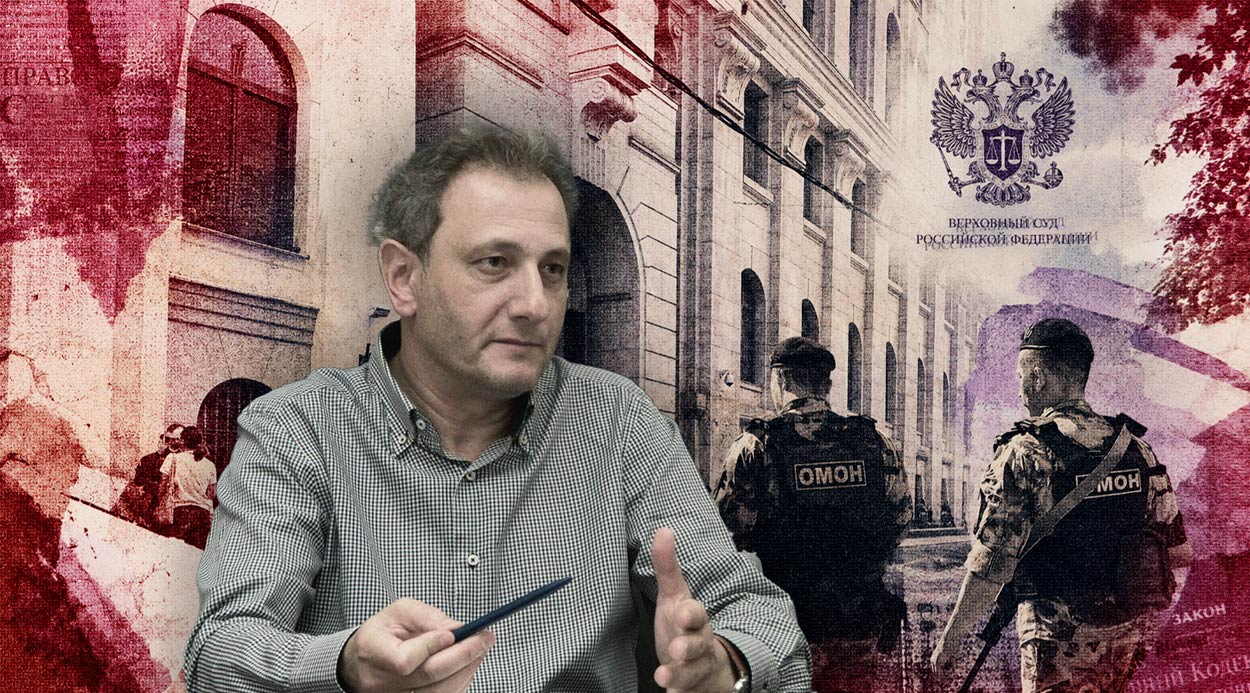
Andrey Kolesnikov
Yevgenia Albats*: Andrey, let's start with the latest news: the Yabloko party was removed from the State Duma elections. What does all this mean?
Andrey Kolesnikov: I think they initially decided to boost turnout, believing that Yabloko would not seriously change the political landscape, would not gain many votes. And then, when it turned out that people were enthusiastically expressing a desire to vote for Yabloko, they got scared of the party. More precisely, not the party, but those formations that pretend to be parties. They got scared that even with election control, Yabloko would take votes from them. The guys decided to use a quasi-legal procedure to remove Yabloko from this field, which began to heat up again, as in twenty-four, when Nadezhdin* was preparing for the presidential elections, and there were queues to submit signatures for him. So history repeated itself. This is a similar typological mistake of the authorities' political technologists. It all looks absolutely terrible because everyone got excited again, there was some hope that there would be a legal platform from which someone would say anti-war words. Obviously, the threat was considered serious by the authorities. So they decided to remove it. The Supreme Court has turned into something very similar to the Duma in terms of stamping various decisions that were not made by the court. Or the judges are already such that they understand everything perfectly themselves. <Chairman of the Central Election Commission> Pamfilova said in the morning that there might be adjustments in the ballot. Already (at taxpayers' expense, by the way) they printed the papers, and it turns out they need to be reprinted. She was clearly warned. So one scheme was devised, and then it was corrected. Someone didn't coordinate something with someone. Amazing guys, of course. And these people call themselves social architects...
The Window of Opportunity Closed
Yevgenia Albats: The Supreme Court has long been a puppet in the hands of the executive branch. But what surprised me the most, to be honest, were the hopes associated with the Yabloko party. And this is after the authorities forced Nadezhdin out of Russia, and he went into exile. Where did such incredible hopes for the Yabloko party suddenly come from? It never distinguished itself by particular bravery.
Andrey Kolesnikov: Nadezhdin was also quite a systemic politician, but under certain circumstances, he became a hope. Here you can play with words for a long time, hope dies last, but that's exactly what happened now when suddenly some window of opportunity appeared, people got excited and were ready to vote. That is, those who previously did not intend to vote in these quasi-elections decided to go. I know from many acquaintances, for whom Yabloko is not at all native, but people said: "We will go with the whole family and vote for Yabloko or for those candidates who are running in the district from Yabloko to show that we exist, we have not disappeared."
No matter how you feel about Yabloko, it was a window. People wanted to use it. Now it has closed, and now people of an intelligent, liberal disposition will not go to the elections
Yevgenia Albats: Who are we? Are these people who are against the war, or are these people who support Yabloko's position, which practically suggests that Ukraine should surrender and then deal with everything else?
Andrey Kolesnikov: These are people who are generally against the war and against Putin. A fairly generalized position, in this situation, there would be no time for details, but now it's all over. Now these hopes have also melted away. No matter how you feel about Yabloko, it was a window. People wanted to use this window. Now the window has closed. Now people of an intelligent, liberal disposition will not go to the elections. In fact, the authorities didn't particularly need this. I don't understand why they started this. Despite the fact that the party is in a completely strange position. Eight people are sitting. Some are already after the verdict, some are before. Absolutely terrible sentences, terrible reasons for them. At the same time, the party has a legal basis for existence. There is a headquarters in Moscow. Well, either release the people or ban the party since you don't need it. They don't need it, they don't need any schemes now. And this is surprising. Previously, there were quasi-liberal parties, there were some subtle Surkov games, and now everything is straightforward. Now everything is covered with a slab. And suddenly they arrange these dances. What was the point, what do they want - it's unclear. It is characteristic how the small Duma parties were alarmed. It would seem, what can surprise us in the current circumstances, but since they surprised us by allowing Yabloko to participate, some annoyance and disappointment still exist as emotions.
Yevgenia Albats: Alexey Venediktov* wrote on his Twitter that the Kremlin believes they can gain 5%, and therefore they got scared. Do you think they could really overcome the barrier? After all, Yabloko has not crossed this barrier for a long time.
Andrey Kolesnikov: These are evaluative things. Most likely, at first, they decided that they would indeed gain 2%, and it would be possible to say: you see, the party taking an anti-war position does not gain votes. And that's it. They are outcasts, no one needs them. Then, when liberal enthusiasm began to unfold about the fact that you can finally come and vote, fears arose, what if they gain a whole 5%? And it's no coincidence that "Fair Russia," "Motherland," and the LDPR started running around. Accordingly, they had to change the concept, as in the joke, they decided not to put the model at risk so that it would not look disadvantageous for the Kremlin - that is, the party that takes an anti-war position would enter the Duma. This could not be allowed. They decided to play it safe in advance. They got burned on Nadezhdin, got burned in the thirteenth year on Navalny**. Maybe it's not worth repeating this. Why did they start? Well, they made mistakes in their assessments. They didn't think that people might take to the streets. Now people are standing at the Supreme Court, which hasn't happened for a long time. And it seems to me that there have already been reports that some people are being detained. This hasn't happened in a very long time. Why don't Russians take to the streets? Because it's dangerous. And today they went out, despite the obvious danger, that's how high the emotion was in support of the slightly opened window.
Don't Look for Logic
Yevgenia Albats: Elections have always been the responsibility of Sergey Kiriyenko, Deputy Head of the Presidential Administration. However, I read that the Second Service of the FSB is now also involved in the elections. And in fact, we are observing a tug-of-war between Kiriyenko's people and the second service. Do you know anything about this?
Andrey Kolesnikov: Such conversations are ongoing, and it seems to me they are not without reason: colleagues were corrected by more serious comrades. Like, guys, your business is social architecture, measure your percentages, deal with the masses, teach them Putinism, engage in education, bring children under our banner, and we make the decisions here. Let's turn the machine around. Such a version is quite plausible in the current circumstances, when the same civil wing clearly lost the story with internet restrictions that were in April. They probably didn't want to crush Telegram and everything else, but they had to crush it because more serious guys said, yes, we need to cancel everything to hell.
Yevgenia Albats: How is the internet in Moscow now?
Andrey Kolesnikov: Well, in Moscow, it's normal. Although there is already a different understanding of normality, in the center, Telegram stops working from time to time, but this is already such normality, everyone is used to switching from one VPN to another. This one works, this one doesn't. Something slows down, something doesn't open, you look for another option. But still, everyone sits in Telegram, it's still the main means of communication here.
Yevgenia Albats: Then what was the point of banning Telegram and declaring Durov** an extremist? What's the point if, as you know, the Kremlin itself uses Telegram?
Andrey Kolesnikov: I think they have special conditions there, some special VPN just for them, and everything works there. But why should the people communicate unnecessarily? Despite the fact that it is indeed strange from the point of view of Kremlin propaganda because the most popular Z-channels, the most popular pro-Kremlin channels are precisely in Telegram. Television works with a passive audience, and here are the guys who are subscribed themselves, watch everything, look at all this horror. And Z-Telegram is much more aggressive than television. Television shows a kind of good picture, and these ones excite hatred, aggression, resentment in people. This is their tool. They decided that it's still better not to have it. Leonid Ilyich Brezhnev is credited with the phrase: "Don't look for logic" - this is what he said about the decisions of his own government. He turned out to be a wonderful person, as it turned out, compared to some.
Yevgenia Albats: At least now there are more political prisoners than under him.
Andrey Kolesnikov: Yes, they surpassed.
There is a normalization of madness. If on TV they say that a bomb can be dropped, and there are smart people sitting there in ties, then why not drop it? "Everything, everything, we will solve the problem. There will be the capitulation of Ukraine right away." Although there will be no capitulation after this, there will be escalation, and it will be bad for everyone
Yevgenia Albats: You mentioned Z-channels, how they incite hatred. I saw various pro-state and state polls that seem to show that people direct their anger in connection with the bombing of Wildberries warehouses not at the authorities who brought the war to Moscow, to Russia, but at Ukraine. A person who just flew from Moscow told me that the mood among those he had to talk to (they were also in the Rostov region, in Altai, etc.) is that, of course, the war needs to be ended, but first, a nuclear bomb should be dropped on Ukraine. How much does this correspond to real sentiments? Or is this a propaganda ploy?
Andrey Kolesnikov: No, this is not a propaganda ploy. This is quite typical mass behavior. The war needs to be ended. And we need a more serious guy at the top, or we will lose. This is a mass sentiment. Such is the mass psychology, that's how people are arranged. Now very interesting research is being conducted by colleague Elena Panfilova (she used to head the Russian branch of the organization "Transparency International - Russia"*. - NT) together with the "Levada Center"*. They are doing focus groups, and she had a group of forty-year-old Moscow moms. Recruitment for them is kind of normal. Well, what's wrong with a bomb? Well, we'll hit, we'll win, there will be peace. And what about Hiroshima, Nagasaki, how about that? They answer: look, the Japanese didn't respond. It doesn't occur to them that the Japanese didn't have an atomic bomb, they couldn't respond. And what about Chernobyl? Well, Chernobyl was localized, there is some zone. And nothing will happen to us. Why us? We are good. Putin says we have a miracle weapon.
Such sentiments exist. And the same Lena talked about a trip to the deep Rostov region. And there is already a clear scheme: first fatigue from what is happening, then irritation that internet restrictions and the fuel crisis were added. And there is hatred towards everyone, both Ukrainians and Putin. Everyone is a goat, and we survive as best we can. Everyone is a sheep, and we will deceive everyone. We are for ourselves. This is the very collectivist people who are attributed with sobornost, community, and everything else. People work with elbows. People are dissatisfied with the outside world, on the one hand, they are pressured, on the other hand, they are pressured, everywhere is bad, there are also shellings, and alarms, and everything in the world. That is, there is a range of very diverse feelings, it is very difficult to generalize what people actually think. And then we see the Yabloko party and that people who were not visible went to the streets for this very party. Where are these Russians who are against the war? Well, here is part of them. Another part sits at home, is afraid, but dreamed of going to the elections because they gave a legal opportunity to express their opinion, and there is no other tool. At work, you can't say, there they will write a report on you, only at home. And even at home, sometimes there are also conflict situations, and here you went and voted. But now you won't go. These people exist, there are many of them.
Yevgenia Albats: Nevertheless, how much does the desire to "drop a bomb" on Ukraine reflect broad layers of the population? Including in the Rostov region, which is just next to the war. And secondly, aren't they afraid that a radiation cloud will easily cover both the Bryansk region, and the Belgorod, and the Kursk, and the Rostov, and so on?
Andrey Kolesnikov: It is difficult to talk about the sentiments of the border regions, one can only judge by people's stories because conducting sociological surveys, I'm afraid, is a complicated thing. And according to what Moscow moms say, there is a feeling here that you are far enough away. Despite the fact that now in the Moscow region during the dacha season, people sit fatalistically, because no matter which area you take, it flies over everyone, and everyone says: "We don't sleep from three to four in the morning." Nevertheless, people who could solve the problem at once are not worried. Absolutely no one cares about anything. And besides, there is a normalization of madness. If on TV they say that a bomb can be dropped, and there are smart people sitting there in ties, then why not drop it? "Everything, everything, we will solve the problem. There will be the capitulation of Ukraine right away." Although there will be no capitulation after this, there will be escalation, which can lead to the death of life on Earth. Some crazy failure of normal research!.. In general, madness is normalized. This is evident from mass questions, from their dynamics. People have forgotten about the nuclear threat. Gorbachev freed the world and Russia, the Soviet Union from fear. This fear has not been there for almost forty years. People have forgotten what it is, that it is not a joke, that it will be bad for everyone. Every person in the Soviet Union knew about unacceptable damage. It is surprising that these things are now being said by deeply Soviet people, who are over 60, or even over 70, in the mass, including the head of state. What is wrong with their logic, what is wrong with their human receptors? They probably have completely dulled.
Flirting with the Bomb
Yevgenia Albats: Among Z-bloggers, there are many critics of Putin who call him weak precisely because he is not ready to "drop the bomb," who say that "the old man has completely lost his touch" and does not understand that this needs to be done now, and so on. How marginal are these sentiments and how much do they reflect the sentiments of the guys in uniform?
Andrey Kolesnikov: Such sentiments exist not only among Z-bloggers. They are clearly popular, they are clearly heard. And a person from the crowd or a conditional Moscow taxi driver, on whom something is always checked, can reason in exactly the same way. I don't talk to taxi drivers, but one of our mutual friends knows how to talk to them. He practically convinces every taxi driver who says that thanks to the bomb there will be peace. He asks them a simple question. And what will happen if they respond to us? And they agree with him: well, yes... That is, people have no opinion. They have an opinion from the air. As a rule, they are also skeptical about everything. About Putin, and about Ukraine, and about anything else. That is, if people are asked the right questions, they can change their point of view.
In short, sentiments can move in different directions. But there is definitely a group of aggressive turbo-patriots who cannot be moved from their place. Aggressive, resentful, inciting hatred in themselves and others. There are a lot of them. I think there are about as many of them, on a conditional sociology scale, as there are people with liberal views. From 15% to 20% of the population from each edge. And in the middle are people without an opinion, who are ready to change their position depending on external circumstances, on dominant opinions. In principle, this is how most societies are arranged. In this sense, we are not unique.
Yevgenia Albats: And how do people from the nomenklatura feel about these flirtations with a nuclear bomb? It's no secret that there are many millionaires and billionaires in both the civil nomenklatura and the nomenklatura in uniform. They probably don't want their even currently arrested villas and yachts to turn into nuclear dust.
Andrey Kolesnikov: I think they don't want that. But my circle of communication is slightly different, more often these are people with technocratic, liberal minds, respectively, their position is clear in advance. For them, this is just complete horror, a nightmare. But they can't really prevent this, their degree of influence is very low. Their wishes, or requests, or attempts to intercede for someone, for example, get stuck in the upper layers of the atmosphere because someone up there says: "And I'm not going to him, go yourself if you break through." They don't need extra troubles.
Yevgenia Albats: And that's why Melnichenko's letter appears in Economist.
Andrey Kolesnikov: I think that's partly the case.
Yevgenia Albats: When Moskovich's "Rusagro" was taken away, nationalized, and he himself was imprisoned, I was told that people went directly to Putin, tried to get Moskovich out, but after that, everything was taken away from Moskovich and - he sat and will sit. I don't think Putin makes the decision alone, obviously, there is some broader collegial body that makes such decisions and does not allow deviations.
Andrey Kolesnikov: I think he gives them a range of possible decisions, and then they decide on their own.
Yevgenia Albats: Do you have an idea of who is around Putin now, to whom he gives options for decision-making?
Andrey Kolesnikov: Specifically, it's not very clear, but in principle, the special services have become such a management company of the "Russia corporation."
Yevgenia Albats: They became that in 2015, right?
Andrey Kolesnikov: And now it has become even more obvious, their power has increased. Therefore, schemers and great combinators are no longer needed as much and have moved to the background. Kiriyenko has practically fallen out of the public eye. All his guys are tinkering with something, dealing with ideology, publishing the "State" magazine, where they write about collectivist values, launching philosophical journals at the philosophy faculty of Moscow State University and at the Higher School of Economics. They are writing a unified philosophy textbook. This is what you guys should be doing, providing us with such software, such a cloud of knowledge, so to speak, a kind of dope. And we make real decisions.
And when they eat each other alive, the Moskovich story happens. Well, it would be one thing if he went against Putin or did something wrong. But no, the person needs to be rolled up. Why? I don't know, maybe he's too talented. Or not too obedient, although I don't think so, everyone is obedient there, but maybe there are some gradations of obedience. Recently Potanin met with Putin publicly. These meetings are not closed. So everything is fine with him, he has positioned himself correctly, he continues business, and so on and so forth. Probably, this can be interpreted that way. Maybe Moskovich was less communicative and didn't have direct access, thought that business is business, he is part of the RSPP and therefore will survive. But no RSPP has stood up for anyone for a long time.
New Normality
Yevgenia Albats: I can't help but ask you about all these rumors about the explosions (or explosion) that were heard in many districts of Moscow. RBC wrote that it was a "Su-35" breaking the sound barrier. Did you hear anything?
Andrey Kolesnikov: This physics is unclear to me. Nothing burned, there were no casualties, it would be impossible to hide. But it was heard over a vast territory. I live in the west of Moscow, we felt this powerful bang, the car alarms went off, a shock wave passed. And this was felt in many districts of Moscow, which are separated from each other by a large distance. Something extraordinary happened. But no explanations, the next day was the weekend, music, fun, festivities, summer - everything is normal for people.
If you walk around the center of Moscow, everything is not just normal, but hyper-normal. A lot of entertainment. Bolshaya Nikitskaya is full of glamorous people sitting in open restaurants. It's something from Fellini's "La Dolce Vita" and even cooler
Yevgenia Albats: Another interlocutor, who shuttles between Rublyovka and Monaco, told my good friend that Moscow is wonderful, lots of delicious food, new restaurants, people are happy with everything. How much does this correspond to reality?
Andrey Kolesnikov: Well, Moscow is a big country, it has many different cities. There are many differences, many enclaves. Like in any giant city. Of course, there are areas where everything is normal, everything is fine, people are walking. And try to rent a room in a hotel in the Moscow region now - it's impossible. The prices are absolutely outrageous. If you walk, especially around the center of Moscow, everything is not just normal, but hyper-normal. A lot of entertainment, and even made with talent, I would say, you can entertain children in the most different ways. Bolshaya Nikitskaya is full of glamorous people sitting in open restaurants. It's something from Fellini's "La Dolce Vita" and even cooler. But this is Moscow, firstly. Secondly, behind the second, third layer, completely different processes are taking place: stagnation of salaries, supposedly low unemployment, in fact, just with the preservation of jobs or with a short working week. And this, in general, is starting all over the country. Terrible expensiveness. They can tell themselves that they have five percent inflation, but don't tell this to people who go to the store twice a week and see what's happening with price tags on food and clothing. All this irritates people. But now it's summer, it's always easier to live in summer. Airports are overcrowded, everyone is flying somewhere.
Yevgenia Albats: I read that flights are being canceled. Has this become customary? Normalization of madness, as you call it?
Andrey Kolesnikov: Yes, normalization of disaster. And fatalism, another manifesting property. Take the same Gelendzhik, where a drone fell, about which no one stirred, no one even declared mourning. Fellow citizens died, including children. So what, it fell in the recreation area, right? People are still going there to rest. Only Crimea seasonally failed because it became impossible to live there. And yet people rushed there, tried to go there. There is something, of course, abnormal about this, but we see that different gradations of abnormality are perceived as a new normality after some time. This is how we live. We still can't influence anything, and what now, not to rest, or what? It's expensive to go to Altai. I'll go by train past this very line of contact to Gelendzhik somewhere. Many, it seems to me, still haven't realized to what extent this military state is serious. Even despite the flying drones. If it didn't hit me, then it didn't hit anywhere.
Here, in fact, not political scientists, not sociologists, but psychologists need to work. This is food for psychological experiments: to what extent can a person adapt to everything, follow the general mood, the mainstream.
Economy Around Zero
Yevgenia Albats: You said there is hidden unemployment, but for a long time, they said that unemployment in Russia is 2%. It's like it's not there. And this is a very bad sign. Many civilian enterprises complained that their workforce is leaving for military enterprises since they are subsidized by the budget, and the salary is, of course, higher there. And this was associated with the problem. But do I understand correctly that the problem is also that the economy has started to sag significantly?
Behind each of the figures that Putin juggles with, there are people's problems. You have a military economy, huge money is being invested, you enjoy 4% growth. But what people need is not growing
Andrey Kolesnikov: It has structurally changed significantly. And there is a sector that is not supported, that is, the market one, which survives as best it can, paying insane taxes.
And there is a sector supported by the state, but even there growth is slowing down. Interesting processes are happening there too, related to the inefficiency, maybe, of the people who work there. Probably, there is still a shortage of personnel there, but somewhere this shortage is no longer there. As labor market specialists write, in some places, an old Russian scheme arises, in which formally there is no unemployment, but people are idle, their salaries are lower, or they are sent on vacation. This also happens at some enterprises. What is happening in small and medium-sized businesses? There are certain difficulties, the story with Wildberries showed this. So behind each of the figures that Putin juggles with, there are people's problems. The insane growth of the economy is also a classic of the genre. You have a military economy, huge money is being invested, you enjoy 4% growth. But what people need is not growing. People have a demand for something else. So what? Then we see zero GDP growth, around zero industrial growth on average.
Yevgenia Albats: Even with these military expenditures.
Andrey Kolesnikov: Even with these expenditures. There can't be no problems with the economy in what is happening now. Bloomberg proposed a very accurate term: Dutch military disease, when unjustifiably high salaries grow in one sector or another. Or the Spanish disease, the result of importing gold into Spain in the XV-XVI centuries. It's all the same! You have problems in the economy starting, guys. What did you hope for? Putin was supposedly educated by our liberals in 2000, they showed him how the economy works, and he should understand something. Now next to him is <economic advisor> Oreshkin, he probably meets with Nabiullina. They just give him some other picture. Sometimes it seems to me that he is engaged in self-hypnosis: we are developing, the rate should be lowered. Poor Nabiullina, under colossal political pressure at the last Central Bank meeting, lowered the rate. There are no grounds for this. Everyone understands this perfectly. Well, this is such a situation: we lowered it, maybe we'll lower it again, or maybe we won't, as it goes. But this is political economics, not economics as such. I think it's very hard for poor Nabiullina, on whom all the dogs are hung, to which she has no relation.
Yevgenia Albats: Well, except for the fact that she is an accomplice, a collaborator.
Andrey Kolesnikov: This is a well-known matter, collective Hjalmar Schacht (Minister of Economics of Nazi Germany. - NT), as it was said back in twenty-two. You convince yourself that you are saving the Russian people while simultaneously saving despotic power. And what outweighs here?
Yevgenia Albats: In recent weeks, I've had to talk a lot with very famous economists, this is Konstantin Sonin, Oleg Itskhoki. When you ask them directly how the economy can withstand 4 and a half years of such a war, such human and resource losses, the answer is: I don't understand. Do you have an idea of how it withstands this?
Andrey Kolesnikov: I have one answer. The market, the working market, which was built not by these, the market economy was built from scratch by Yegor Timurovich Gaidar. What a powerful impulse it was that allows people to survive. To supply food under shelling, despite the destroyed WB warehouses, despite the tax burden. There is practically everything in the stores. There is no problem buying this or that product. You can order any item you need on marketplaces. There is Ozon, there is Avito, where people trade with each other. Freedom of trade, the decree of ninety-two. Please, people, trade with each other. And people trade. Where does everything come from? How does it come here? Somehow it comes. Fantastic entrepreneurs are Russian people - this is my only explanation for what is happening under the nightmarish circumstances in which the economy is forced to operate.
And, of course, the demographic crisis must be mentioned, there is no one to work. You can announce another partial mobilization. Who will drive trolleybuses, buses, taxis, who will work at enterprises that produce something for people?
Yevgenia Albats: So there is a noticeable shortage of men?
Andrey Kolesnikov: Well, of course! Then there will be no market because the market consists of people. If people end up in the trenches, who will work?
Yevgenia Albats: And do you think that mobilization will still happen? There are a lot of speculations about this now, but it's unclear what might actually happen.
Andrey Kolesnikov: I think there is no decision yet. They expanded the number of criminal offenses with which you can participate in the SVO. Including banditry and something with drugs, against which they are very strongly opposed and paste warnings on children's books that they contain mentions of narcotic substances. They want to plug the holes with such human material. This suggests that they are still afraid to make such a decision. I think it is postponed until the period after the elections. Although the election result, I'm sure, does not affect this at all. This is just a procedure that should take place. Here you are, our dear fellow citizens, voted "for," legitimized the SVO once again. In twenty-four, they legitimized it with Putin, now with parliamentary elections. Everything is okay, we move on.
Now everyone is talking about the fact that the war has changed, drone operators are needed. Therefore, educated people should be mobilized, not just some mass, otherwise, there will really be no one to work. But the country is a classic garrison state. You look at the graduation in different schools, whole classes - drone operators, ordinary Moscow boys graduate from specialized classes. They say guys from math schools are valued. They have everything very serious there. They are being prepared for eternal war with civilization. This is the horror of our today's education.
They Cleared the Country
Yevgenia Albats: I read in one post the following reasoning, that in fact, we must give Putin his due, he effectively liquidates the ballast in the form of the federal penal system. Colonies are closing all over the country because they are emptying, because people are being sent to the combat zone, they are being killed there. And the problem of cleansing society from the criminal element is wonderfully solved. What would you say to that?
Andrey Kolesnikov: That the criminal element is people, citizens of the Russian Federation. That this does not correspond to our laws, does not correspond to our constitution, does not correspond to Christianity, which they boast about at every step. They have some special Christianity. We see this in the monstrous statements of Patriarch Kirill. He's quite a Christian.
And in general, the motive of "cleansing" sounds all the time. When it all started and there was a big wave of emigration, Foreign Minister Lavrov said: "Well, the country is being cleansed, all sorts of troublemakers have left, real patriots of our Motherland remain." When the fuel crisis began, unexpectedly from oblivion emerged the former head of Rospotrebnadzor Onishchenko, who was once called the informal Minister of Foreign Affairs because he closed the import of goods from various republics that "behaved badly." This Onishchenko said: "Well, without gasoline, they will travel less, the air will become cleaner." The fact that they will travel on terrible gasoline and the air will not become cleaner did not occur to him.
A colleague told me about a private conversation with another former colleague who is now on the pro-government side. "He suddenly said to me: it's good that you all left." Not that he directly said that the air became cleaner, but the motive of cleansing sounded. Not everyone has been cleaned yet, but the work is ongoing.
Yevgenia Albats: Last question. We personally know Sergey Karaganov, the head of the Council on Defense and Foreign Policy, who used to wink when talking about Putin's international policy, and now directly advocates for the use of nuclear weapons against the West. I remember well Fyodor Lukyanov, who was initially horrified by the invasion of Crimea, and now easily acts as the organizer of Putin's Valdai Forum. This list can be continued. Is this Soviet conformism or is there something else?
Andrey Kolesnikov: It seems to me that Soviet conformism was ethically less pronounced. Everyone behaved like that, everyone understood everything, it was kind of a legally split consciousness, everyone winked at each other. Here, too, there was winking, but it ended after it was said that nuclear war is normal. You can probably switch to the other side, but not under such circumstances. I know that some people who worked for the Kremlin, after the adoption of the "Dima Yakovlev law," said to themselves: we can no longer work for the system, it has gone bad, this is not right. For some, perhaps, the annexation of Crimea, then the start of the SVO served as a reason to become disillusioned with the regime. Many of our popular relocants used to cooperate with the Kremlin, with Surkov: this is supposedly such political glamour, there is nothing special about it. I don't think they thought then that they were building an authoritarian system. Putin is rational, we'll get through, the economy is fine, the borders are open. But they left. Many already have criminal cases, many have administrative cases. Someone is forced to justify themselves for something, but it was a long time ago, people made mistakes. And there are those who switched to the other side. Someone says they are a soldier, someone justifies themselves. But they are doing fine. They are beneficiaries, they are now out of competition - in the academy, in universities, in expert councils, they are media figures. They are supposedly defending the motherland. A different time has come.
Yevgenia Albats: But they understand that this ends sooner or later. They saw how the Soviet Union ended. They know how the thousand-year Nazi Reich ended. They know how the insane cannibalistic regime of Pol Pot in Cambodia ended. They know that these regimes are finite. Do they not understand or do they think they will be able to flip over and prove that they were actually defending the fatherland?
Andrey Kolesnikov: I think there are two motivations here. Some think that this regime will last long enough for their lifetime, despite all sorts of economic difficulties, that they will live their lives under it, both active and retirement life. They will serve peacefully until retirement, and after us, the deluge. And the second explanation is that maybe it won't last our lifetime, everything is shaky and the boss is nervous, he's going somewhere wrong, and in general, it's getting scary, but there are examples of exits from dictatorships when systemic people were needed. Mostly, however, technocrats were needed, who dealt with the economy, but also politicians, the Spanish example is proof of that. We will say that we restrained the system from more severe steps from the inside. We behaved so honestly there that they didn't drop a nuclear bomb on America. This is our merit. So take us as we are. Return us to international connections, to the academic councils of Western universities, where we once were, to think-tanks. We will also tell you how everything really was. This is the position of a backup evacuation exit. Indeed, no one can predict whether we have a thousand-year history of all this ahead, or this thing will work, as Vasily Rozanov said: "Russia slipped away in two days. At most - in three." This is subject to attempts at explanation, political speculation, but in fact, we cannot predict how everything will develop...
Video Version
* Yevgenia Albats, Andrey Kolesnikov, Boris Nadezhdin, Alexey Venediktov, "Levada Center," "Transparency International - Russia" in the Russian Federation are declared "foreign agents."
** Alexey Navalny, Pavel Durov are on the list of "terrorists and extremists."
Photo: carnegieendowment.org.