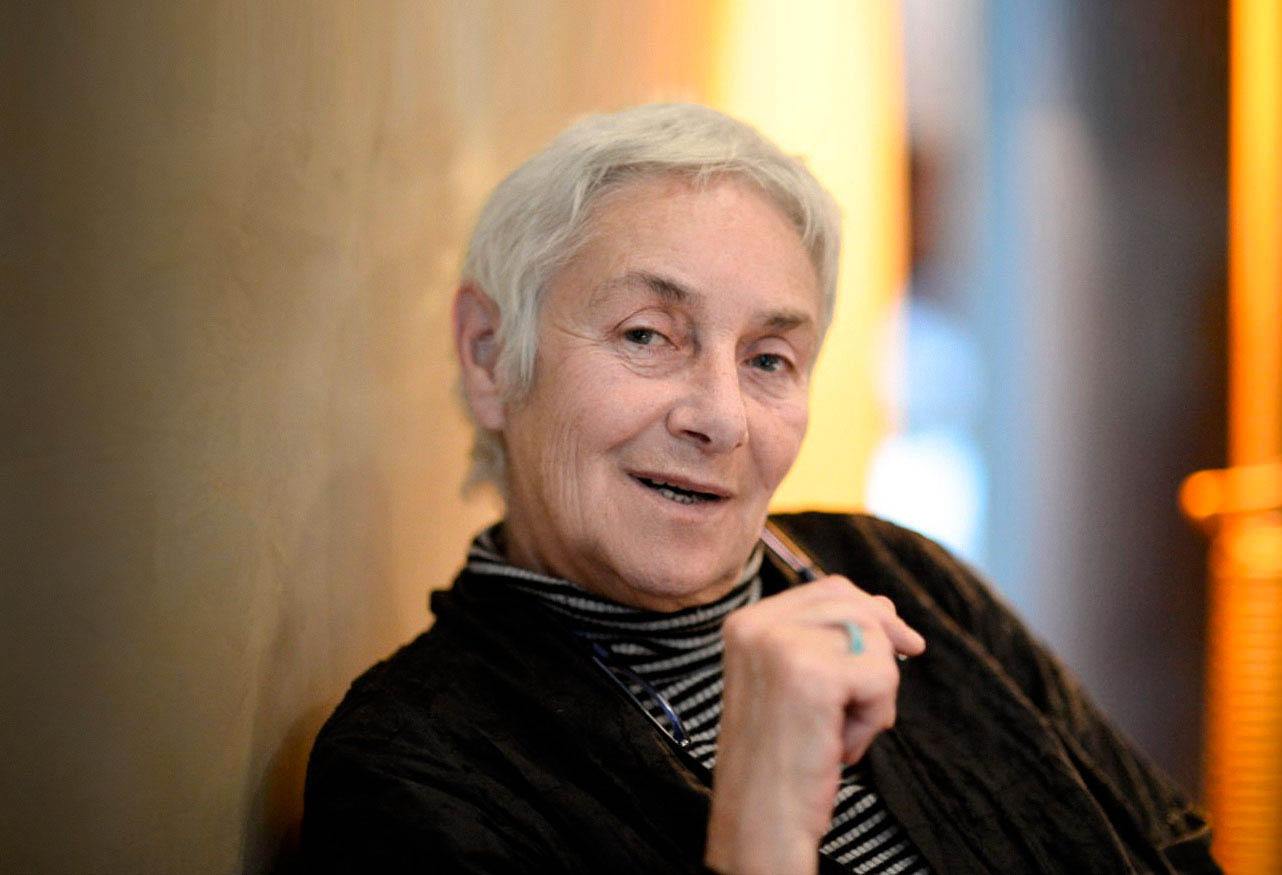
Masha Slonim. Photo Māris Morkāns
Evgenia Albats*: Masha, your book has just been released, titled «Returns. A Non-Serious Memoir». For me, it's a fascinating story of life in the Soviet Union, both dissident and a bit bohemian, and life in America and the UK. We will talk about it. But first, I wanted to ask you, what recent events have caught your special attention?
Masha Slonim: The ongoing bombings of Ukraine. Another nightmare in Kharkiv, in Odessa. A family died yesterday. It's simply impossible to read about this without pain. I read the news every day because I believe we must not forget about it. We need to remember, remind, and know. At the same time, you know, we live some kind of double life, right? On one hand, there's real life, which truly affects people, wars, killings, and so on, and on the other hand, there's also the virtual. I can't help but follow what's happening on social media. And of course, I was impressed by the interview with Denis Kapustin, done by Yuri Dud, and the interview with Petr Ruzavin, done by Katya Gordeeva. Both of them are fighting on Ukraine's side, and this somehow unites them, although they are completely different interviews and different characters.
Real and Virtual Life
Evgenia Albats: Let's say for those who don't know, Denis Kapustin — is a Russian nationalist...
Masha Slonim: Well, why nationalist? I consider him a Nazi.
Evgenia Albats: ...the leader of the Russian Volunteer Corps, and he is fighting on the side of the Armed Forces of Ukraine. Petr Ruzavin — our former colleague, because he took up arms. He worked for «Dozhd»**, worked for various émigré publications, filmed a lot. But eventually decided that journalism doesn't help anything now, doesn't solve anything, and started working as a drone operator directly on the front.
Masha Slonim: But if we continue listing the events I follow and that amaze me, it's, of course, the war of the USA and Israel against Iran. Maybe now, since I don't particularly write for anyone except on Facebook***, for me, these are phantom pains, because as a journalist, important news occupies, worries, and concerns me. I'm very, very worried and concerned about Trump's madness and the fact that the world is somehow on a thread due to the strange, inconsistent, and, in general, crazy behavior of the American president, his friendship with Putin, the alliance of the Kremlin and the White House. Everything is very alarming.
Evgenia Albats: Returning to Yuri Dud's interview with Denis Kapustin. What impression did it make on you?
Masha Slonim: I must admit, I didn't watch all five hours. I watched in pieces, fragments, in retelling. Basically, clips. How can I say... I have some anthropological interest, as it were, in this breed of people. I have never met them, fortunately, closely. But here he completely revealed himself, I think. Although when there were questions about attitudes towards Hitler, Goebbels, «Heil Hitler» — this «Roman salute», as they coyly call it, — I directly saw, heard the pauses, how he tries to carefully choose words, because he already considers himself a representative of some political force, and not just a gang of football hooligans, which he used to be. He clearly claims something important in the future. For now, he is training, playing war games, as it were. But, in general, hair-raising. And it's great that Yura showed it because why hide it? They exist. I had a seditious thought. It seems to me that in the terrible Russia of the future, such Kapustins can easily unite with the veterans of the Special Military Operation, with Z-war correspondents, because they are somewhat similar. They are now fighting on different sides, but they can unite. Ideologically, they can complement each other. I don't know, maybe it's my fantasy, but there was such a creepy feeling. And I feel sorry for him, I have the feeling that all his activities, about which I know little, are some kind of overcoming complexes. Maybe he was beaten in childhood, maybe something else. A very funny moment when he brings a birth certificate to the interview. He thinks about it in advance — that he will show this certificate to prove that he is not Jewish, although his grandfather is Jewish. It's funny and pathetic. Although he tries to look smart, he knows something from history. It's turned upside down, distorted... Anyway, we got to know a little more about this, which is good, I think.
Evgenia Albats: Look, how interesting. We have a very different impression of this Denis Kapustin. For me, he is a classic product of anti-Semitism. A boy who all his life hid that he had a Jewish grandfather. It's clear that he was constantly poked in the face in the nationalist, even neo-Nazi environment. He came to Germany with his parents on a Jewish visa. That is, the parents managed to prove that somehow they were persecuted in Russia for their Jewish roots. And it's absolutely clear that he was looking for an environment where he could apply his strength and rise to leadership. And this environment was exactly the one that required him to be a true German. In Germany, it's still not so easy to be Jewish, as it seems.
Masha Slonim: That's what I'm saying, he was overcoming childhood complexes.
Evgenia Albats: The second thing that upset me immensely is that when he tells Dud that for Germans, Hitler was good, and how this interview is commented on in the émigré press, no one refuted his arguments that it was good for Germans. Neither about what the German industry was built on under Hitler, and it was built on robbing Jews, nor about the lie that allegedly Hitler came to power democratically. In fact, he committed what in historical science is characterized as a legalistic coup. Becoming Chancellor of Germany, Hitler introduced a law in the Reichstag that allowed the executive branch in a parliamentary republic not only to introduce laws but also to pass them. And then he just dissolved the Reichstag. Therefore, all the talk about Germans electing Hitler democratically — is nonsense. These are stories for uneducated people who know little about Nazi Germany. But I was upset that Russian programs did not take the trouble to verify what Kapustin said and comment on it, simply consult experts.
I agree with you that Petr Ruzavin's interview with Gordeeva is interesting, although I have questions about this interview, and questions about a journalist taking up arms.
Masha Slonim: No, he declared that he stopped being a journalist. And then he took up arms. He stopped being Russian, became Ukrainian. He says Ukraine is his country.
Evgenia Albats: Don't you think that he actually became a mercenary? That he went to fight for money?
Masha Slonim: No. No. What does it mean for money? Ukrainians, Ukrainian military are paid money? They are paid, everyone is paid. He, I know, signed a contract. But those who come by conscription also receive some salary. I believe him 100%. He went by the call of his heart.
And he loves Ukraine, he says: «This is my country». He is now fighting for his country against the country he was born in. I think he is a very integral person.
Return to Oneself
Evgenia Albats: Let's talk about your book. Why the plural — «returns»? Is the title yours or the publisher's?
Masha Slonim: Mine. I came up with everything myself. And «non-serious memoir», and returns. I believe my emigrations — are in some sense a return to myself. The first emigration — I kind of returned to England, to the country of my English ancestors. I knew a lot about it, from my grandmother and from literature. We read English books with her. And it seemed to me that yes, this is partly my country. And I returned. It seemed to me that I returned forever. Then I returned again to the Soviet Union in eighty-nine — to work. Returned, like slipping into old slippers. I recognized everyone, and friends were still alive there. And it seemed to me that I returned to myself home. And then the country stopped being mine, and I returned to England. Now I also have a return forever. I can't imagine now that I could return to Russia, that I would live to see it in a sane mind and solid memory, live to see the Russia that would suddenly again seem mine, home, native and warm, beloved. Although I have relatives there, and friends, and I remember everything. But no, I don't want to now, completely cut off.
It seems to me, I am a cosmopolitan, I can't say that here is my country, and I am ready to fight for it. I hate war. I am fine where I am and the dogs. And friends, of course, are a wonderful bonus
Evgenia Albats: For those who haven't read your book yet, it should be said that Masha's grandmother Ivy married the Bolshevik Maxim Litvinov before the revolution. Then she moved with him to the Soviet Union. Litvinov was the People's Commissar of Foreign Affairs, then the Soviet Union's ambassador to the United States during the war. You talk about returning to both the Soviet Union and England. And for you, which country is yours?
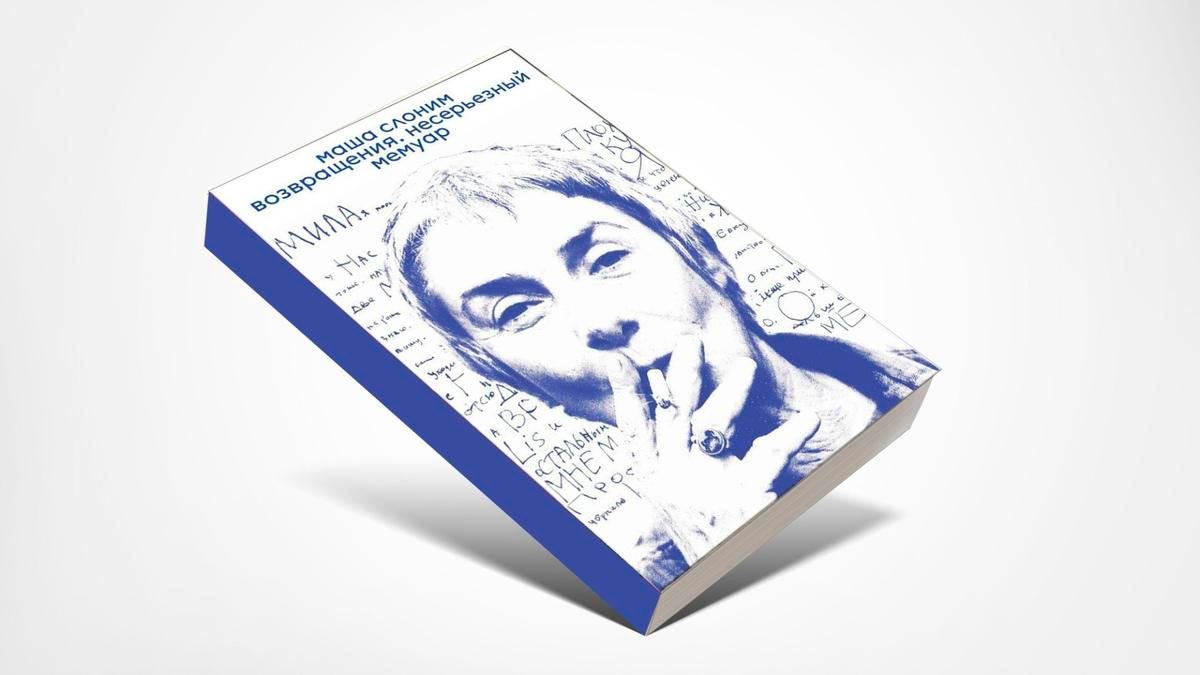
Masha Slonim's book
Masha Slonim: I feel equally good now in England, as I felt good up to a certain point in modern Russia, as it was, in general, in the Soviet Union to a certain extent, because I was young, because life was interesting, friends, and love, and so on. It seems to me, I am a cosmopolitan, I can't say that here is my country, and I am ready to fight for it. No, I am never ready to fight, I hate war and when they shoot. I am unprincipled, obviously. I am fine where I am and the dogs, let's say. Well, friends, of course, are a wonderful bonus. I have fewer friends here now, although there are some. No, I can't say where my country is. Probably, by birth, I am from there. And Russian is my native language, and the culture is more Russian than English. Although my grandmother gave us an injection of English culture from early childhood. I also write about this — about her experiment: an English childhood in a Russian village.
Evgenia Albats: You write that your grandmother took you from the house on the embankment, where you lived in the large apartment of the People's Commissar of Foreign Affairs, to a rented dacha in the Moscow region «to shelter from everything Soviet and nourish with everything English: English books, children's songs, music, healthy food, and relative freedom. Although English upbringing was strict. Daily wiping with cold salty water. Oatmeal for breakfast. No candies or sweets at all». And did you speak with your grandmother there at the dacha in English or Russian?
Masha Slonim: In English. But she exclusively in English, and we answered, in general, in Russian. And even were embarrassed when she, say, shouted something to us in the bus: «Children!..» She had a loud voice, she didn't care about anyone. She was a very free person. And we pretended that she wasn't our grandmother. We weren't with her because we wanted to be like everyone else. But we understood, of course, in English, when they whispered with my mom, when mom came and something interesting sounded. I asked: «What does it mean?» — when I didn't understand some adult things. Mom said: «Well, it's an untranslatable play on words». So English was in our house when my grandmother was with us. Then, of course, they took us away from her. And we already communicated, coming to her in the summer. And only at 18 years — I just remember this, I lived with her at the dacha — I realized what a fool I was. And I started speaking English, answering her in English.
English Grandmother
Evgenia Albats: You write that Ivy — you called her Gema, right? — was constantly looking for new English-speaking friends. And found mainly among the wives of former Soviet agents. She befriended Melinda Maclean. Melinda managed to be married twice to agents of Soviet intelligence in England. First to Kim Philby, and then to Donald Maclean. These wives were probably in the Soviet Union after their husbands were taken to the Union, and an ordinary person could not meet them. These were very secretive people.
Masha Slonim: This was already, I think, in the sixties. Melinda gave her newspapers, The Times, I remember, such a rustling thin newspaper. And books, my grandmother couldn't live without books. This was a source of some more or less modern literature, because they received something from England.
Evgenia Albats: How was she allowed to these people?
Masha Slonim: I don't know. I just don't know, I was still little. I was friends with Maclean and Melinda's daughter. She lives in America now. I came to say goodbye to her before leaving. And Maclean came out and said so sadly: «Well, I wish you happiness in your new homeland».
Evgenia Albats: He was one of the «Cambridge Five», he worked in the Ministry of Defense, do I remember correctly? We read that wonderful book about Philby together.
Masha Slonim: The book is wonderful, yes. He was such a nice old man, sad. They were all sad, naturally.
Evgenia Albats: Gema could also go to the British embassy and even bring out forbidden items...
Masha Slonim: This was my mom, later, in the late sixties. The cultural attaché invited the intelligentsia to the embassy on Sofiyskaya embankment, where she grew up as a child — there was the residence of her grandfather. And she brought books from there, somehow hid them, and they didn't search at the exit. So we had books from there: «YMCA-Press», «Posev».
Evgenia Albats: You write about how Gema at some point went to Sverdlovsk when Litvinov, your grandfather, had an affair with some secretary.
Masha Slonim: She was his assistant.
Evgenia Albats: Gema was very offended by him and went to Sverdlovsk. And wrote a letter saying that she might be killed. How serious were these fears?
Masha Slonim: Completely serious. These were the thirties when they arrested left and right. In the government house, as they told, there were «night weddings». That's what they called searches and arrests. They heard all this. A miss, a hit, from above, below, from the side. They came at night to take people away. So, of course, she had fears. Although she was quite naive and open, too open, with this American, who then turned her in, wrote a denunciation — through whom she tried to send a letter to the world: if I disappear, don't believe that I killed myself, I loved life, I loved St. James's Park, listed all the dogs and cats, my mom and my uncle Misha — listed everyone. What saved her, probably, was that she went to Sverdlovsk.
Jewish Grandfather
Evgenia Albats: When you said you were writing a book, I thought you would write a book about your grandfather because Litvinov is a completely historical figure. He was one of the old Bolsheviks, whom Stalin shot almost all. How did Litvinov manage to survive?
Masha Slonim: There was an assassination attempt planned on him, we know this. On the way to the dacha, his car was supposed to get into an accident. There was a case against him, all his assistants in the People's Commissariat of Foreign Affairs were interrogated. Many were imprisoned, they demanded testimonies against Litvinov. The family's version is this. He was respected in the West, he spoke at the League of Nations, was an ambassador in Washington, and so on. He was a figure, he was not treated like Molotov. He did not sign the non-aggression pact, he would not have. And in general, Hitler directly said that he would not sign a pact with a Jew. Then they removed my grandfather. This was quickly resolved, it was not a problem for Stalin. But the version of my parents, mom and grandmother, is that he was kept for a possible thaw in relations, friendship with the West, since he was known in the West. So to speak, the liberal face of Soviet power. That's the only explanation.
There was also a story in the family that when my grandmother's letter reached Stalin, he met my grandfather in the Kremlin corridors, showed the letter and said: «What shall we do with your wife's letter?» — my grandfather looked and said: «Let's tear it up». And supposedly Stalin tore it up. Memorialists, who gave us a folder with denunciations when they were allowed into the KGB archives for a short time in ninety-one, found correspondence between Moscow and Sverdlovsk on this matter, found the denunciation itself and reports, but did not find the original letter, but found some funny translation made by one of the Sverdlovsk employees. Probably, Stalin really tore up this letter, because among all the papers there was no original. Well, the only version — is that he kept my grandfather for an emergency, just in case.
Evgenia Albats: And why did he remove him?
Masha Slonim: Because the pact with Hitler had to be signed. And after the war, my grandfather returned from Washington and remained an employee in the People's Commissariat of Foreign Affairs. Stalin supposedly offered him the post of Minister of Culture, but my grandfather refused. And until forty-six, I think, he remained on staff. And even seemed to go to work, because he gave an interview to an American journalist for CBS in his office.
Evgenia Albats: Litvinov said there that Soviet leaders cannot be trusted. This is still under Stalin, forty-sixth year! But he gives this interview, and the Americans, as you write, decide not to publish it. Because they thought it was unsafe for Litvinov.
Masha Slonim: Yes, it's a death sentence.
Evgenia Albats: But what prompted him? Why did he decide to make such statements?
Masha Slonim: It was clearly his testament. The CBS journalist says that when he came, Litvinov was sitting by the fireplace, although it was late May or June, terribly hot, the asphalt was melting underfoot, and he, my grandfather, had a fire burning, and he was burning something there. He was waiting for arrest, of course. No, CBS acted amazingly. They sent a summary of this interview to the State Department to familiarize them. The interview was very pessimistic. That you can't negotiate with the USSR because if you make some concession, they will demand more. Plus, he said that there is absolutely nothing to expect from a change of generations because the young were brought up and grew up in the same system as the old. There was a conversation about control over nuclear weapons, and he said that in democratic countries it is harder to hide something, he meant as opposed to the USSR. In general, he warned in every possible way. From CBS they sent a summary of this interview to the State Department, and it began to be printed in several issues of Washington Post almost the next day after my grandfather's death. That is, they waited until fifty-one.
Evgenia Albats: And this didn't leak to the Soviet Union?
Masha Slonim: Well, of course, they eavesdropped on him, and there were denunciations, they knew he met with foreign journalists. But somehow it had no consequences.
The school in Moscow was near the government house. All the children from this house went to this school, and somehow they didn't want to send us there. So I went to a village school for the first two years
Evgenia Albats: Did you communicate with your grandfather at all? Was he interested in the family?
Masha Slonim: Very much. He was terribly affectionate. He adored us. He gave us some candies. He himself had a sweet tooth. And we pilfered them from his desk drawer. So sometimes he opened the drawer, hoping to treat us, and the candies were already gone. No, he loved us very much. He was a tender, tender, tender grandfather. My grandmother did a terrible thing. She took us away from our father and grandfather. The father at least sometimes visited us. And we were only taken to the house on the embankment to bathe. Because there was a bath and so on.
Evgenia Albats: And there was no bath at the dacha?
Masha Slonim: It wasn't a dacha. We had nothing of our own when we were growing up. We rented half of a village house, what kind of bath. So they brought us to Moscow, to my grandfather, it was a holiday for him and for us too, because a big apartment, polished parquet. They didn't want to send us to school in Moscow, it was near the government house. All the children from this house went to this school, and somehow they didn't want to send us there either. So I went to a village school for the first two years. He missed us. I think he missed his grandchildren.
Patriots
Evgenia Albats: You write very little about your grandfather's activities before the revolution. You kind of skip over it.
Masha Slonim: Well, I have some materials, like how he escaped from Lukyanovskaya prison in Kyiv and something else. But you have to work with archives. I'm not an archive person. It's a separate job, and I didn't dare, because then you have to do everything very meticulously and conscientiously. There are some materials about underground activities, how he bought weapons in Europe for the revolution. He was such a bourgeois there, he even had a business, but in fact, he was buying weapons. He had an interesting life in Europe until he was caught with bonds that were seized during the expropriation of a bank somewhere in Tiflis, and he was supposed to launder them, exchange them. They were numbered, and he was caught trying to exchange them. But by a happy coincidence, he was a lucky guy, the French deported him not to tsarist Russia, but for some reason to England, where he met my grandmother. Otherwise, it's completely unknown what would have happened. My grandmother was an adventurer and a frivolous literary young lady. She wasn't a socialist, but she had leftist views, and most importantly, she fell in love, he was charming, and they had children in England, my mom and her brother Misha. My grandmother didn't exactly rush to Russia, although she was curious, I think.
Evgenia Albats: And when did Litvinov realize what they had done?
Masha Slonim: He didn't openly talk about it. And certainly not with me, I was little. With my mom, of course... They understood very early. And that's why they even wanted to send their daughter, my mom, to England for upbringing. They understood a lot. Arrests were happening around. But he was a patriot, he still believed he had to do something useful in the country. He went to Washington when Stalin made him ambassador to convince Roosevelt to open a second front, and lend-lease, and so on. Yes, he worked for the country.
Evgenia Albats: He probably could have stayed.
Masha Slonim: You see, the thing is, my mom didn't go. She was a patriot too. «How can I leave the country when my country is at war?» And then my grandfather said: «Okay, then marry Slonim». They weren't exactly planning to start a family. But that's how it happened. My mom worked, she was an artist, and she painted roofs with camouflage and extinguished incendiary bombs. Then they evacuated to Samara, to Kuybyshev, she kept losing her ration cards endlessly...
Evgenia Albats: Don't you think that what you're telling about Tanya Litvinova, your mom, somehow interestingly echoes Petr Ruzavin's interview?
Masha Slonim: Maybe, my mom was a very integral person. She knew everything about Soviet power. She was just sick from the fact that everyone around was being arrested. This is already in my memory, dissident, so to speak. She helped the families of those imprisoned. She was very close with Nina Ivanovna Bukovskaya when he was imprisoned. She took it very much to heart.
Evgenia Albats: I learned from the book that you, it turns out, saved Solzhenitsyn's archive.
Masha Slonim: Well, no, it's too loudly said — saved. I was part of the team that took the papers out of the apartment. For some reason, they didn't search when he was arrested and taken to Lefortovo. And so quickly, Natasha organized everyone who had acquaintances with foreign journalists, and we started going there just like to work. I came with a bag, took something out, passed it on. They watched us. A little white minibus followed me.
Evgenia Albats: You were even summoned for interrogations. Once, when you were resting somewhere, they made you come to Moscow, and you took a ticket in a sleeping car and made them pay for your trip
Masha Slonim: Yes. But only there in the sleeping car, and back still in a regular carriage.
Resistance
Evgenia Albats: Tell me, how did it all start? You grew up in the house on the embankment, it's a completely separate life. You have an English grandmother, your mom is an artist, your father is a sculptor. Why did you go into this dissident life? And such a dangerous dissident life. You took parcels to your friends in prison, you even tried to send caviar to Garik Superfin, bought in the government «canteen number one». How did it happen that you started doing this? What you did, very few people did.
Masha Slonim: Well, no, many...
Evgenia Albats: You photographed books that were then distributed. That's 7 years in camps — for distribution.
Masha Slonim: First of all, I lived only until the age of seven in the government house. And even then, mostly we lived in a village house, where we had no caviar, nothing else, and there were all sorts of deprivations. We pretended with my sister that we were eating ice cream, but we sucked either butter or some dry sticks of yeast. Gema didn't want us to stand out, although she spoke to us in English. We were free people for some reason, thanks, probably, to the English upbringing.
Evgenia Albats: Who got you involved in dissident activities?
Masha Slonim: We had friends from university years, there was a Moscow crowd. First, you are somewhere in the third, fourth circle from the center, and then, as people were arrested, you get closer and closer. There were fewer and fewer people, and someone had to do all this. Not to mention that because of English, because of English friends who then came — graduate students, foreign journalists — there was an opportunity to pass some things abroad.
Evgenia Albats: You were involved in distributing the «Chronicle of Current Events». Sergei Adamovich Kovalev received 7 years for the «Chronicle of Current Events». Superfin was also imprisoned for the «Chronicle».
Masha Slonim: But they were involved in the «Chronicle». Superfin, among others, at my house. Yes, he collected all this — letters from camps and so on. Everyone knew he was doing this. And when they came to me with a search on his case, they started looking around: so, where do you keep the archive of the «Chronicle of Current Events?» The archive of the «Chronicle»!.. I had marks on the wall, the guys ran up the wall in rubber boots, and there were marks leading to the ceiling. And the investigators conducting the search looked at these marks: «So where is your archive?» I said: «Well, they lead there». And we had a nine-story building without attics, but they looked so puzzled... We were among the few in our company who had separate housing, everything was very convenient. You could print, and I had an enlarger, I made films. And then I photographed pages.
Evgenia Albats: Well, that is real 7 years.
Masha Slonim: Yes, I both produced and distributed. They knew, of course, they watched.
Evgenia Albats: You write about Pavel Litvinov, your cousin, who was one of those who went to the square in sixty-eight when Soviet tanks entered Czechoslovakia, and there was a big noise in the West that the grandson of a former Soviet ambassador and commissar was imprisoned.
Masha Slonim: Well, yes. And partly because of this, it was more advantageous for them to release me. They were still afraid of noise then.
Evgenia Albats: That's the question I wanted to ask you. You went through quite harsh years of Brezhnev's Soviet Union, your friends were imprisoned, you stood in lines and passed them food parcels, went to the camp, etc. Comparing with today's Putin's Russia, don't you think that the regime is harsher now?
Masha Slonim: Harsher, harsher. Then you had to do something serious to be imprisoned, like Kovalev, like Superfin. I would probably have been imprisoned eventually if I hadn't left. Now, for some post on social networks, for nonsense, people get such terms. And Berkovich and Petrychuk for a play. Then they judged Sinyavsky and Daniel, but it was the publication of books in the West, for the Soviet authorities some unheard-of audacity. And now for price tags in a store, for a picket with a blank page, you can get a term. No, harsher and more ruthless. Then they pretended to comply with some laws. There was no such impudence, brazenness, lawlessness, which is already happening at the legal level.
Evgenia Albats: The reason is that the people in power had experienced Stalin's time and the constant horror of expecting arrest. People on the Old Square, in the Central Committee of the CPSU, were terribly afraid of the return of the uncontrolled NKVD-KGB. And therefore, purely out of a sense of self-preservation, they restrained the Chekists.
Masha Slonim: There was still a post-Stalin thaw, there was a memory of the repressions. Then they told about it poorly, but they told, the memory was still fresh. I think they walked on thin ice and didn't want to fall through. And these, it seems to me, don't care anymore, they don't care at all.
Life and Love
Evgenia Albats: You write quite frankly about your infatuations. I never heard from you about Andrey Zaliznyak, a talented linguist, a scientist who studied birch bark manuscripts, in particular.
Masha Slonim: He was a genius.
Evgenia Albats: But you also write about various other infatuations.
Masha Slonim: And husbands. I had four husbands. At some meeting in a London bookstore, a woman asked me: «How did you have four husbands?!» I said: «Well, that's how it happened». In general, that's how it happened.
Evgenia Albats: But at the same time, you write that the only one you truly loved was Andrey Zaliznyak, who never left his wife, but with whom you met until his death when he came to the West. There was some strange triangular alliance.
Masha Slonim: And I love them all very much. And I still keep in touch. I am friends with his beloved wonderful daughter Anyuta.
Evgenia Albats: You publish a photo where the three of you are: you, Andrey Zaliznyak, and his wife. There is also one with Anyuta, I think.
Masha Slonim: I was very anxious and afraid of how she would read all this. And she wrote: «Thank you, how wonderful that you did this».
We were the first generation that lost fear. My parents' generation still had this fear. They remembered the terror. But we, born after the war, lost fear
Evgenia Albats: What role did love, sex play in your life? Including in dissident activities?
Masha Slonim: Well, you went too far. It's life in general. I had a diverse life. Everything was like a normal young person.
Evgenia Albats: But you write about dissidence as if it was such a fun. Why, for example, was left-radical protest popular in the West, often among young people from wealthy families?
Masha Slonim: I think it was a protest against parents, roughly speaking, against the previous generation. And with us... We lost fear. We were the first generation that lost fear. My parents' generation still had this fear. They remembered the terror. But we, born after the war, lost fear. At some point, I realized that we were playing a little. That I was playing, for example, how to evade surveillance. We didn't have cars, but there were passageways. And it seemed to me that it was a bit of a game. They won, they were professionals, and we were amateurs. That's why they took people when and how they wanted, cat-and-mouse games. They were the cats, and we were the mice. But at some point, it seemed that we were outplaying them. When Garik Superfin was being dragged for interrogations almost every day, he came and told everything. Once he forgot something, I jokingly said: «Listen, well, next time take a tape recorder with you». And I had a small cassette player. Of course, it was a joke, but when he came to the next interrogation, they said: «So, Superfin, put the tape recorder on the table». That is, they listened to us in real-time. And then we found: some guy came to me, a specialist who knew everything about this, and we climbed to the technical floor and found a black box that led to my phone line. They listened to us, and we played and thought we were outplaying them.
Evgenia Albats: But you outplayed them. You are a classic example of outplaying them. You not only survived in this situation, you wrote a book in which you tell everything. And of course, they look like complete idiots.
Masha Slonim: Well, yes, but if my mom hadn't pushed me out... I didn't want to leave. It seemed to me that there was still a lot to do. People were still in prison, and in general, life, life.
Evgenia Albats: And your mom understood that you would be imprisoned?
Masha Slonim: Of course, she pushed me out like from a burning hut. It was a whole epic, but quite quickly, in two months, I was given an exit visa.
Evgenia Albats: Well, that's because Henry Kissinger helped, do I understand correctly?
Masha Slonim: Yes. I was on his list. It was already détente, the beginning of a thaw. They released me directly with a Soviet passport for permanent residence in the USA. The passport expired in a year, and that's it. And I was free. They deprived me of citizenship without my participation. I was already living in England, working for BBC. Well, in general, they deprived me. They just issued me an ID, and when it expired, they gave me a Nansen passport, a refugee certificate, although I didn't ask for asylum, I just said I wasn't returning.
Evgenia Albats: And when did you get a British passport?
Masha Slonim: Gorbachev came, these very chummy-chummy with Thatcher began, I thought: «So, it's time!» And I applied. And I got it. And for the first time, I went in eighty-seven already with a passport on a tourist visa, to look around.
Evgenia Albats: Masha, it's terribly interesting to listen to you and very interesting to read. There is no feeling of absolute horror, as often happens when you read dissident books.
Masha Slonim: My mom said, I remember very well: they say, horror, nightmare, the thirties, arrests, terror. But we lived, we fell in love, we had children. Life went on, life, you understand? And now it seems to us from the outside that it's horror-horror, but people live there. Depression, of course, but they live. They go to the theater...
Evgenia Albats: They set up a communication iron curtain. People without the internet in the XXI century.
Masha Slonim: They jammed us too. It seems to me, they are so stupid, so backward. They may slow down time, but it won't work. This young generation will come up with something else. And they will outplay them. They are trying to drag the country into yesterday. But it's unrealistic. It's a pity for people who are losing their lives. But they will lose, that's for sure.
Masha Slonim — a well-known Russian and English journalist, long-time host and correspondent of the Russian service of the BBC, author of documentaries about Gorbachev and Putin. The granddaughter of Stalin's People's Commissar of Foreign Affairs Maxim Litvinov. Was married in her second marriage to Baron Robert Phillimore.
Video Version
* Evgenia Albats is declared a «foreign agent» in Russia.
** «Dozhd» is recognized as a «foreign agent» and «undesirable organization».
*** Facebook belongs to Meta, declared an «extremist» organization.