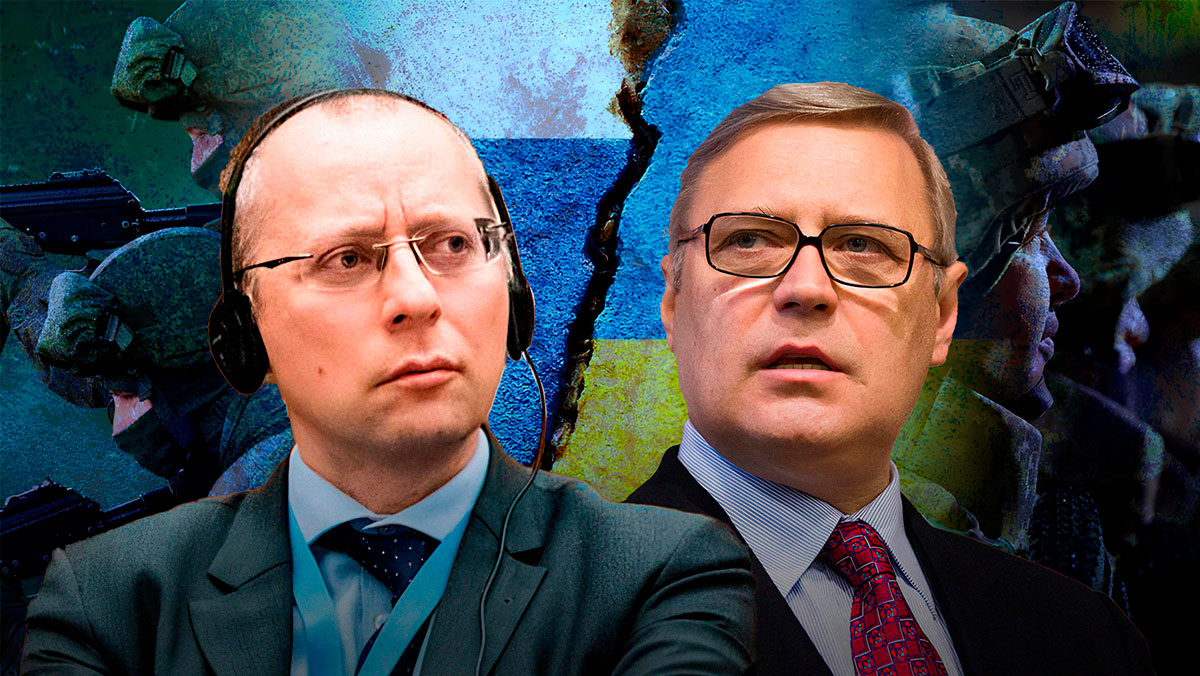
Boris Bondarev, Mikhail Kasyanov
Yevgenia Albats*: Today we will talk about the main topic of recent days — another round of very strange negotiations regarding the cessation of Russian military aggression in Ukraine. Do you think these negotiations can end in anything? Or is it another deception?
Mikhail Kasyanov: It's not a deception, it's just another round of negotiations. The problem is that the parties have completely different understandings of how peace should be formed. It sharply differs between the US administration, Ukrainian leaders, European leaders, and Russia. Different positions. Therefore, I see no prospect that this round of negotiations will end in any agreement.
Boris Bondarev: It seems to me that the main misunderstanding among all the participants in the negotiations is that the Americans somehow believe that this is a war between Russia and Ukraine, and Russia and Ukraine should negotiate. And the Russian leadership believes that this is a war of Russia against, in fact, the US and their Western allies through Ukraine, which is perceived more as a proxy. And, accordingly, Russia is trying to reach an agreement with the US, that is, of a more global nature. And here, it seems to me, is the main contradiction: one side understands what it wants and tries to achieve some progress, while the other side, which shows the greatest activity — the US — works, in general, not understanding what it is doing.
Putin Manipulates
Yevgenia Albats: During a press conference in Bishkek, Kyrgyzstan, where CSTO members gathered, Putin suddenly revealed details of an upcoming meeting with American negotiators in Moscow. Allegedly, during another meeting of the Ukrainian and Russian delegations in Abu Dhabi, an unplanned representative of the American side appeared, "made contact" (characteristic vocabulary, isn't it?) with the Russian representative and suggested meeting in Moscow as soon as possible. "The issue is so important for everyone and for us," Putin said, "that we will fly at any time of the day or night." Is it a usual thing to agree on a meeting regarding upcoming negotiations in this way?
Boris Bondarev: In such a presentation, it looks somewhat strange because the meeting between Russian and Ukrainian representatives was clearly planned, it wasn't something sudden, they happen regularly, discussing the issue of prisoner exchange and the logistical moments accompanying it. The American Secretary of the Army Dan Driscoll, who flew there, decided to meet with the Russian representatives. It was an approach to people who don't know what to answer because these people from the FSB came there with a specific assignment to discuss the exchange of prisoners of war. They don't know what to say to the Americans, who say — let's have a meeting in Moscow about resolving the war. They are there for a different issue. It seems to me that this approach demonstrates the unprofessionalism of the American side, specifically those representatives of the Trump administration who are trying to fulfill the president's assignment to establish relations with Russia as quickly as possible. If you want to have a meeting, there are traditional channels of interaction for this. And even in those conditions when the work of the embassies in Washington and Moscow is hampered for a number of reasons, they still work. Information exchange is ongoing. You can pick up the phone and call. We see that calls are constantly made at a high level. And for this, you don't need to come to someone else's meeting with some non-thematic statements. It looks strange and unprofessional.
Putin wanted to demonstrate the Americans' interest in negotiations and their desire to energetically work with the Russian Federation. All this will later be laid down in the Anchorage agreements
Yevgenia Albats: I think General Driscoll, who replaced General Kellogg as the special representative of the President of the United States in Ukraine, flew to Abu Dhabi precisely because after the meeting between Dmitriev and Whitcoff in the US and the leak of the 28-point peace plan, the Americans decided that they needed to quickly force events and agree on a meeting in Moscow. And this happened after Trump and Putin talked on the phone. Mikhail Mikhailovich, you know Putin well, you worked with him and have been observing all these years after being forced to leave the government. Why did Putin start talking about Abu Dhabi? After all, he never does anything just like that.
Mikhail Kasyanov: I wouldn't attach such importance to this meeting in Abu Dhabi. And why did Putin say this? Precisely for the same reason that it was also unexpected for him that a high-level American representative made "contact," as you noted, with Russian representatives. Putin wanted to demonstrate the Americans' interest in negotiations and, in general, their desire to energetically work with the Russian Federation. All this will later be laid down in the Anchorage agreements, allegedly there were some understandings, mutual understandings, and so on, tracks that were agreed upon there. I remind you that one of the main topics in Alaska was Russian-American relations. Putin, in every possible way, and his propagandists following him, emphasized that relations between Russia and the US are the main prospect. Ukraine is a regional issue, we will solve it, but the meeting and cooperation with America is an important direction. Within this logic, he decided to once again indicate that the Americans are very interested in interaction at all levels. I think that the leak of the peace plan project also played into Putin's hands, as it confirmed to the whole world that the American proposals are Putin's proposals. And he achieved victory: finally, the negotiation process is based on the project proposed by Putin. That is, Trump's plan is essentially Putin's plan. Then we can talk about how it transforms, but the fact remains. Putin wants to manipulate Trump and is starting to do it again.
Yevgenia Albats: Why is it important for Putin that everyone knows that it is not he who is asking for peace, but that the Americans are asking to meet with him?
Mikhail Kasyanov: Besides subjugating Ukraine, Putin's second goal is to gain respect from the world personally for himself, for Putin. So that the whole world knows that the fate of the world is decided by two presidents, decided between the US and the former USSR, now Russia. And that they will not deal with some trifles like the fate of Ukraine, but will solve issues of disarmament, non-proliferation of nuclear weapons, decide the fate of the world, what to do in the Middle East, what to do in Africa, and so on. So that the whole world listens with bated breath: well, they signed an agreement, there will be no nuclear war... Putin wants to reduce everything to this. And with his nuclear blackmail, he also spurs such a feeling in the minds of not only Russians but also Europeans.
Why is Trump in a Hurry
Yevgenia Albats: The acceleration of the Americans, their desire to meet with Putin as quickly as possible and agree on something, again pressure on Ukraine. Could this be related to the fact that in areas close to Venezuela, huge American forces are concentrated, the sky over Venezuela is closed, and so on. In the US, the media writes that Trump is preparing for an invasion of Venezuela. Of course, against this background, negotiating peace in Ukraine would probably be strange. Do you think this could be the reason why Trump suddenly accelerated?
Americans still think that it's not the aggressor who unprovokedly attacked the victim, but that two bosses quarreled, and now they need to be somehow seated next to each other so that they agree, so that each side makes concessions
Mikhail Kasyanov: I don't think these are interconnected things, and I don't see reasons why this should stop the negotiation process in Russia and Ukraine. Another thing is that Trump now has less interest in this, he understands that it is not possible to agree directly with Putin, so he is ready to support any efforts: 28 points, the actions of one minister, another. But now it seems Rubio is taking this process more under his control. Maybe something will move forward because among them all he is the most pragmatic and understands the problems of Ukraine.
The fact is that in America they adhere to a completely different logic. They still think that it's not the aggressor who unprovokedly attacked the victim, but that two bosses quarreled, and now they need to be somehow seated next to each other so that they agree, so that each side makes concessions. But even in this logic, when they assume that both sides should make concessions, the Russian side does not make concessions. Trump already said that Putin made a huge concession: he promised not to attack Europe. That's all that can be taken from the Russian side in this logic. This is the problem of the American negotiating position. They want to be mediators. They strive not to put the aggressor in his place, but to somehow appease him. Therefore, among the 28 points, there was a point of full amnesty for everyone. Not the punishment of the aggressor, but full forgiveness for everyone. It's like they quarreled, buried a million people — and nothing, let's forget about it. Of course, this will not be accepted by either the Ukrainian people, the leadership of Ukraine, or the leaders of Europe. It is clear that negotiations based on such a document cannot lead to a positive result.
Yevgenia Albats: Boris Anatolyevich, is it true that Lavrov was sidelined because he is to blame for Trump's refusal to meet in Budapest? Didn't agree with Marco Rubio.
Boris Bondarev: Lavrov hasn't disappeared anywhere. It's just that now Whitcoff has emerged, Dmitriev has emerged, and a non-typical, not traditionally diplomatic, but very, frankly, dirty story has begun. As if from the magazine "Crocodile" a caricature of imperialists who are ready to start wars for the sake of money. As for Lavrov breaking the summit, I can't agree. Lavrov can't say anything to Rubio that Rubio and Trump haven't heard from Putin. Lavrov conveys Putin's position word for word. He has been a minister for 21 years. Bureaucrats with such experience know perfectly well where they can go, where they can't. Rubio simply used this conversation to cancel the summit, to tell Trump that Russia is not making any concessions. By the way, America itself made concessions. Before Anchorage, Trump had the position that a ceasefire should first be established, and then negotiations should be held. After Anchorage, Trump said that we need to talk about peace while conducting military operations in parallel. Putin's position.
It wasn't Lavrov who broke the summit, but Putin's uncompromising position, who insists on his own regardless of anything and seeks no compromise. Actually, Lavrov, as an executor, conveyed this once again to the Americans, and Rubio, as the most sober-minded person, considered it a good reason to postpone the summit and not follow Russia's lead. But, as we see, Steven Whitcoff intervened and broke the whole thing.
Diplomacy of the Looking Glass
Yevgenia Albats: My interlocutors in Washington, well-informed people, say that Marco Rubio learned about the 28-point plan only when it was published by Axios, where, as they write, it most likely leaked from Kirill Dmitriev. You said that this is abnormal diplomacy, that it is a dirty game. Aren't behind-the-scenes negotiations diplomacy? My second question is about the fact that two businessmen have come to the forefront in the United States and Russia. Kirill Dmitriev has some business in Saudi Arabia, he goes there all the time. And Whitcoff has interests in Saudi Arabia, as American media write. At the same time, professional diplomats somehow remain on the sidelines. How does it work, after all?
The American administration demonstrates if not amateurism, then some kind of disdain for established norms and practices of diplomacy, practices of conducting foreign policy
Boris Bondarev: When I said about the dirty game, I didn't mean the form. Communication channels can be different — very official, less official, informal. This is normal. By the word "dirty," I meant the content, which we can observe from the leaks: let's sell allies, let's sell those to whom we promised help, for the sake of business deals. The Dmitriev-Whitcoff channel itself is normal. There are many such informal channels. Diplomacy is a means to get the other side to agree to what you need. And for this, you need to understand what the other side wants and somehow win it over to you. Or put pressure on it. But since Russia is not ready to put strong pressure on the US, because it can get a response, this is not Europe, and there are practically no forces left, except nuclear ones, to influence, so you need to somehow attract to your side. The same Rubio, as we see, demonstrates some intransigence and some more political attitude towards solving problems. That is, you must make some concessions and we must, but we are not ready to leave the positions that the US occupies in the world and in Europe. But there is Steven Whitcoff, who, as can be judged, has long-standing ties with Russian business. He has his own interest. Aha, they say in Moscow, well, here's a person with whom "you can do business". That is, you need to use his predisposition, interest in money, his inexperience in politics, lack of some political vision and understanding. And, of course, his focus on pleasing Trump. This needs to be used. Steven, let's build some kind of tunnel under the Bering Strait, you have 50%, we have 50%, it's huge money. And Whitcoff goes with this to Donald Trump. Russian diplomacy, which, it must be said, has never shone, looks even professional against this background because it uses different methods, different tracks, different methods. It does not limit itself to formal frameworks. The American administration, however, demonstrates if not amateurism, then some kind of disdain for established norms and practices of diplomacy, practices of conducting foreign policy. Recently, Trump boycotted the "G20." He said, Americans will not go because South Africa, where the G20 was held, does not protect the rights of the white population. And now Trump has stated that the next G20 should be held in the US next year and that he will not invite South Africa at all. But it was not Trump who accepted South Africa into the G20. One country cannot decide for others who participates, who does not participate.
Yevgenia Albats: The influence of Musk.
Boris Bondarev: Another such amateur, a lover of all sorts of outrageous things. That is, in such an administration, even Rubio, who is not a professional diplomat, but as a senator has extensive experience and understands political layouts, often looks like a foreign body. He is there more for decency, because there must be a Secretary of State. And Trump would gladly work according to the schemes of Whitcoff and Dmitriev: informally agreed, "settled the issues," solved everything, divided the money and dispersed. No long-term planning, no analysis of political risks, geopolitical and strategic consequences.
Mikhail Kasyanov: But here's the question, why is diplomacy not the main channel of negotiations today. Putin, his entourage — these are KGB people, they have studied Trump, he has long been on their screen, and they understand that the approach to him should be through business. And in order for it to sound good and convincing, they found a person who turned out to be close to the Putin family, who has trust from Putin, so that he invents these transactions. Therefore, the Ministry of Foreign Affairs is a little on the side, and Ushakov is in charge of this. They always had tense relations with Lavrov, and here he is happy to lead Dmitriev, who invents something, plus Dmitriev turns out to be a good acquaintance of Trump's son-in-law. They agree on deals. This scheme works today. Will it lead to any result? It won't. Europeans look at all this with great surprise and with great frustration feel that the main partner does not share the values of transatlantic unity. Today this unity is in question. Today, people of business are mainly in power in Washington. And they are little concerned about the future of Ukraine and security in Europe. The right words are spoken: let's stop, people should not kill each other. But they kind of forget about the rest.
Everything Flows
Yevgenia Albats: You mentioned Putin's assistant for international affairs Yuri Ushakov. We learned that he is a key player in these current negotiations and leads Kirill Dmitriev thanks to leaks of conversations that were passed to the Bloomberg agency. How common is this in diplomacy and in such deals — such leaks?
Mikhail Kasyanov: In the form we saw, this is not a common thing. There may be hints, but for a direct recording of a conversation — I don't remember such a thing.
Yevgenia Albats: And the fact that they are eavesdropping, that they are recording such conversations?
Mikhail Kasyanov: They were talking on WhatsApp. Is this usual or unusual? They thought it was normal. Dmitriev doesn't have government communication, he is somewhere abroad, so any intelligence could record this. The question is, who leaked it, who benefits from it. I believe it benefits Putin. He got two things. First — confirmation that this is his, Putin's, project. Second — Whitcoff's stories about the need to cherish and nurture Trump, praise him, and so on — so that the whole world sees who Trump is. This is within the framework of the manipulation that Putin is carrying out. Everything works to strengthen the image he wants to create for himself.
Boris Bondarev: Leaks can be accidental, that is, unprovoked, and they can be deliberate. This leak looks very deliberate. By the way, it's suspicious that the Russian side reacted so calmly to it. Well, yes, something leaked, well, okay. Although it seems to me that the most understandable and simplest answer is that someone in the American administration leaked it.
Yevgenia Albats: Why?
Boris Bondarev: To prevent such a course of events. I think there are some supporters of a more reasonable approach there. Trump hasn't cleared everyone out, despite all his efforts. But we can only guess.
Yevgenia Albats: In Geneva, a 19-point plan was developed. Do you know anything about it?
Mikhail Kasyanov: I understand that what is unacceptable for Europe and, first of all, for Ukraine has been removed from it. There is no point about general amnesty. There is no point about limiting NATO and EU membership. No point about reducing armed forces. Probably, and about elections within 100 days. No point that Donbass will have to be freed. That's already 5 points for you. Well, something else. But in any case, Moscow will not accept this.
There can be no recognition of the occupied territories as Russian. For Europe, this is a fundamental, most important point: the border cannot be changed by force. The entire security architecture after World War II is built on this
Yevgenia Albats: And what is Ukraine ready for? Considering that there are now big problems there — both at the front and in Zelensky's entourage?
Mikhail Kasyanov: I think the possible option is the one discussed by the Ukrainian side and the Europeans. The line of combat contact is the demarcation. There can be no recognition of the occupied territories as Russian. For Europe, this is a fundamental, most important point: the border cannot be changed by force. The entire security architecture after World War II is built on this. And no one can allow Putin to destroy it. In the US administration, they treat this with less reverence.
Yevgenia Albats: One often hears about the Northern Cyprus option, which was occupied by Turkey, no one recognizes it, while both Cyprus and Northern Cyprus exist.
Boris Bondarev: There are two de facto Cyprus. And no one can or wants to do anything about it. As if everyone is satisfied with everything. The problem is that no Northern Cyprus option is interesting to Vladimir Vladimirovich Putin. The very issue of territories, in my opinion, has been thrown into the Western information space from the very beginning of the war to give them all the illusion that the war is being waged for the sake of land. Give Putin a little territory, and he will stop. That is, the conversation is initially from capitulation positions. But Putin did not start the war to annex several territories. He needs to reshape the entire world order, to put everyone before the fact that this is my sphere of influence, no one climbs here. Neither the Americans, nor the Europeans, no one. I rule everything here, as the Soviet Union used to rule. Naturally, any concession, even temporary recognition that on this territory, captured as a result of aggression, the Russian order is maintained, is already a defeat not only for Ukraine. For Ukraine, there is nothing shameful in this because it is inferior to Russia in all respects — in terms of population, military power. It has been fighting long and worthily, this is already not shameful. But for those who promised to help it, for the US in the first place, for the superpower number one, which, even without wanting to strain too much, immediately says, that's it, we give up — this is a disgrace. Ready to give up, throw under the bus a country to which they promised support, with which they promised to be as long as necessary, including for the protection of territorial integrity, — such words were spoken at the beginning of the war. A UN General Assembly resolution was adopted stating that Russia must withdraw troops from the territory of Ukraine, and so on. No one remembers this.
Northern Cyprus is a wonderful dream for many. I would be more satisfied with the Korean scenario, for example, which is often talked about, but which is somehow very misinterpreted. According to the Korean scenario, the invading forces of the aggressor are sent back to their original positions. And then peace is established according to these original positions. Not according to the positions that the aggressor reached during a successful attack, but when he was returned by force or some other means of pressure to those positions that he occupied before. And he has been sitting there ever since and doesn't particularly move, because he understands that he can get hit. This is a more or less realistic scenario for ending the conflict, when it seems that Ukraine remains an independent state, and the European order is preserved.
Yevgenia Albats: That is, Russian troops must leave Ukrainian territory?
Boris Bondarev: Well, at least as of February 23, 2022. At least.
Yevgenia Albats: That is, Crimea remains occupied by Russia?
Boris Bondarev: And further, if they retreat under pressure, the landscape changes, including the military one. There, Crimea already begins to look different. And the areas of the DPR and LPR occupied earlier also look different from a military point of view. There may already be other scenarios. But this will already be a conversation about a peaceful settlement on strong positions.
Yevgenia Albats: So, as it happened when two Koreas were formed?
Boris Bondarev: They were formed before, and then North Korea decided to conquer the South. But it didn't work out. Because South Korea had normal allies. Unfortunately, Ukraine is not very lucky with allies.
Yevgenia Albats: Americans fought there.
Boris Bondarev: Yes, mainly. And then the Americans placed nuclear weapons in South Korea. And a large contingent remained there.
Yevgenia Albats: Ah, that's where Zaluzhny in his article talks about placing nuclear weapons on the territory of Ukraine. Now it's clear where this idea comes from. I thought it was a fantasy.
Boris Bondarev: Well, it's also a hint at the Budapest Memorandum, of course.
Mikhail Kasyanov: But speaking of Korea, we need to remember that peace came there three months after Stalin's death. In March 1953, already at Stalin's funeral, Malenkov and Khrushchev were saying that the Korean War should be ended and relations with the West should be established. The death of the dictator contributed to the settlement.
Europe Without America
Yevgenia Albats: Mikhail Mikhailovich, you always appeal to Europe's opinion. At the same time, we see that Europeans go no further than endless words. Yes, now they pay for the weapons provided by the US. Yes, the European Union is now covering the budget hole in Ukraine. But all the talk about placing European Union troops on the territory of Ukraine, or blue helmets, ends in nothing.
Mikhail Kasyanov: Well, it's an obvious thing. Europeans don't want to fight.
Yevgenia Albats: But this is happening in Europe. Trump says he doesn't care.
Mikhail Kasyanov: Americans generally say that everything should be given to Russia. I'm exaggerating, but the point is that territories should be conceded. Therefore, I don't think now that American soldiers can be in Ukraine. And Europeans can be, but not in wartime conditions, but for support, as a contingent ensuring security. No one wants to fight. But they will support Ukraine with military equipment and finances. The problem is different — why, you will say, are they so indecisive. And the problem is that the entire NATO structure has been built for decades on the dominance of the US as the main power. And the American contingent was stationed in Europe. And the command. And therefore, when today they say, that's it, take on this role, Germany should be at the head of this matter, they say — okay, we agree. But how to rebuild the system? It was built for decades, and you want us to do it in a year? All the equipment is American, the entire system of management, surveillance, navigation is connected with them, and you can't just drop it. Therefore, the Americans have a special responsibility. But the Americans are not leaving, they just rhetorically pressure and create the impression that there is some kind of split. In fact, there is nothing of this. But Europeans need time. So far, they cannot ensure security without the Americans.
If you do nothing, if you always follow the opponent, do not try to outplay him, impose your vision, your agenda, your initiative, then you will never win
Boris Bondarev: Europe helps Ukraine. Without European financial, humanitarian, military assistance, Ukraine would be in trouble. But in politics and especially in war, what matters is not what you do, but whether you do enough to achieve the result you expect. Unfortunately, everything that the West, including the US, has done in relation to Ukraine for almost 4 years is not enough. We see that Ukraine has no opportunity to stop the offensive. They retreat — slowly, snapping back, trying to make some counterattacks, but for now, they are retreating. This instills confidence in Putin that he will squeeze them. And in Europe, it instills despondency. Americans say that you can't defeat Putin. But they don't make enough efforts! And here it's not about the fact that they don't have opportunities, I think they have a setting: somehow survive this matter. Either Putin will get tired of fighting, or he will die, or the Russian economy will collapse. I said a long time ago that the Western approach, especially the European one, consists of two extreme points of view. The first is that Putin is some kind of natural force, you can't defeat him, you can't stop him, you have to come to terms and do nothing. The second point of view says that Russia is weak, it's a colossus on clay feet, the economy is about to collapse, the Russians will run away, so you can continue to do nothing. Everything converges at the point that nothing needs to be done, roughly speaking. But if you do nothing, if you always follow the opponent, if you do not try to outplay him, impose your vision, your agenda, your initiative, then you will never win. And you will never make him respect you, which we are now observing. Only Ukraine does this, but Ukraine objectively does not possess all the resources it needs. The West can supply these resources to it. It could have supplied them in 2022 in huge quantities. And the Americans themselves admit this. But something always gets in the way. Biden was hindered by fear, fear of escalation. Trump and his friends are blinded by greed, they think of nothing else. Europeans are held back by the ingrained notion that an adult will come and decide everything for us. In 4 years, some measures could have been taken, at least to start building strategic autonomy, which De Gaulle talked about back in the 60s. Then they laughed at him, said, grandpa is rambling. But no, it turns out, De Gaulle was right. And the parliamentary mechanism, which is now often referred to in justification of slow decision-making, did not prevent the UK from fighting in World War II. It did not prevent declaring war on the aggressor in fulfillment of its allied obligations to Poland. It didn't help Poland, but nevertheless, the UK coped with this democratic challenge. That is, problems can be solved in democracies. For this, you need vision and desire.
And one more point. It seems to me that there is a high probability that as soon as some truce is signed, as soon as military actions stop for a moment, in Europe those who will say: peace has come, we don't need defense spending, we don't need to do all this, let's spend on our beautiful life, as we are used to, will rise to their full height. Putin promised that he wouldn't attack, that's it, no need. And when some armed nonsense happens again, Europe will again be unprepared. And this, it seems to me, is a serious danger.
Reference
Mikhail Kasyanov began his career in the Soviet Union as a financier. He was the first deputy minister of finance, minister of finance, deputy prime minister of the Russian government. From May 2000 — Chairman of the Government of the Russian Federation. In 2004, he was dismissed from this post for disagreement with the policy that Putin began to pursue. After his resignation, he became the leader of the Russian right-wing liberals. Member of the Anti-War Committee of Russia**.
Boris Bondarev is a professional diplomat. He graduated from MGIMO, worked at the Ministry of Foreign Affairs of the Russian Federation. He was an assistant envoy in Cambodia, later became an advisor to the Russian Federation's representation in Geneva. The only Russian diplomat who openly declared his protest in connection with the Russian Federation's invasion of Ukraine.
Video Version
* Yevgenia Albats, Boris Bondarev, Mikhail Kasyanov are declared "foreign agents" in the Russian Federation. Mikhail Kasyanov is included in the list of "terrorists and extremists."
** The Anti-War Committee of Russia is declared an "undesirable organization" in the Russian Federation.
Photo: Zakon.kz, A. Zemlianichenko/AP/picture alliance, M. Henley/Panos Pictures via Redux.